MORAN

Multi Operator Radio Access Network

MORAN-Multi Operator Radio Access Network, the name implies the sharing of RAN of two operators. MORAN is mainly used for coverage expansion with less hardware cost.

RAN sharing was standardized from Rel.6.

In two scenarios we can go for MORAN.

  1.  2 Operators are having their own networks in an area.
  2.  Only single operator present in an area. 2nd Operator does not have   their presence.

In both scenarios finally expansion of footprint is the main aim for implementing MORAN.

Scenario-1:

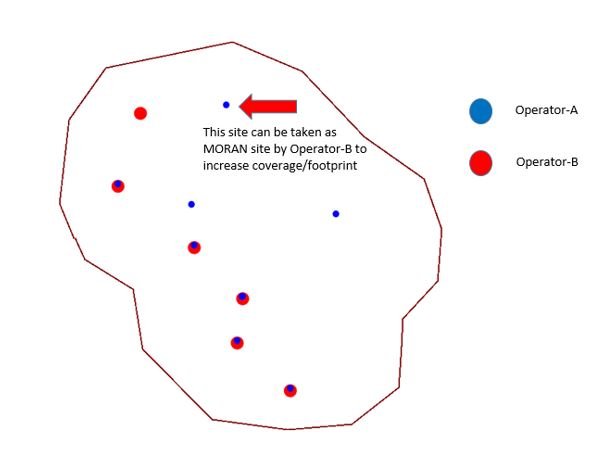
If 2 operators are having their presence in an area, there may be some locations where two operators will have coverage overlap and some locations two operators will have exclusive coverage. So to maximize the coverage area we can select the exclusive coverage sites for MORAN implementation.

If Operator-B is taking a site form Operator-A through MORAN that site will be like a new site for Operator-B.
Scenario-2:

If only one operator is present and 2nd operator does not have coverage then this is totally a new coverage for the seeker operator.

How MORAN works:

In Moran both networks will use same radio equipment, same transmission equipment and bandwidth till the MSC of host network. A connection is established between MSC to MSC of both networks which is called NNI – Network Network Inter-connectivity.

The only thing that we have to define is PLMN of both networks in the same cell. If operating frequency of the 2 operators is same (e.g. both operators are having same spectrum 1800MHz band) then we do not need any extra hardware in a cell.Just we have to define PLMN separately and in BSC this option is available.

If both operators are having different frequency spectrum (e.g. one at 1800MHz and1 at 900 MHz band) and the existing equipment (Antenna and radio) does not support both spectrum then we have to add additional antenna and radio baseband unit.

Transmission media will be same in both cases. Just we have to check that host network has enough transmission bandwidth to support the expected traffic of the seeker operator.

If expected total traffic of the seeker and the host site is more than current traffic handling capacity of the host site, then capacity augmentation would be required. For GSM addition of TRX and for 3G and 4G addition of additional bandwidth (e.g. License up gradation from 10MHz to 15Mhz bandwidth).

Implementation of MORAN:

We can take an example how practically MORAN can be implemented. We are taking this example for a single site for GSM MORAN.

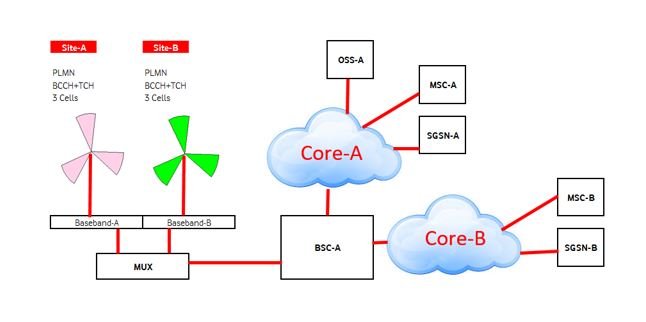
  1. Site – A (Host site) and Site-B (Seeker site)
  2. BSC of Site-A is BSC-A, and Site-B is BSC-B.
  3. Core of Site-A is Core-A and Site-B is Core-B.

 If we consider a scenario where both operator operates in different frequency band need additional antenna and radio unit.
Configuration in Host BSC:

  • Some features need to implement in the BSC
  • Multiple PLMN support in BSS
  • Multiple CN support

BSC and Core connectivity:

BSC-A needs to be connected to Core-B (CS/PS) via NNI.

Site-B cells will be visible in Site-A OSS as these cells are part of BSC-A.

Though this process looks very simple, yet so many definitions and configurations required in both host and seeker network.Additional hardware not required, but involvement and configuration required atRF, Transmission and core end. Once for the 1st time a sample site implementation successfully completed then further tasks become simpler.

So through MORAN concept we can reduce effective cost of a BTS site and without new BTS/Base station we can expand our network coverage footprint.

P.S.- You should also read about ICR-Intra Circle Roaming which is another method of Network sharing method but with different concepts and also what are the differences between MORAN and ICR.

https://saiwisdoma.com/icr-intra-circle-roaming/
https://saiwisdoma.com/difference-between-moran-and-icr/

Thank you for reading so far. You are important for me, please leave your footprint here:

[mc4wp_form id=”173″]

<script async src="https://pagead2.googlesyndication.com/pagead/js/adsbygoogle.js?client=ca-pub-2754967439384345"
     crossorigin="anonymous"></script>
5 Building Blocks of 5G-NR Technology

5G is the fifth generation of cellular mobile communications .Demand for mobile data increasing exponentially across the world. Voice on mobile phone is no more a criteria for selection of any network. The whole telecom market is playing on data only. Consumption of data is increasing drastically in a very short span of time.

As data feasting increasing tremendously so up gradation of technology become necessity with the ecosystem. Data was started with 2G, 3G then 4G and finally with 5G. Technology is upgraded to next generation with an expected high data rate capacity.

Speed-

Technology wise expected speed of data in optimum conditions is as below.

2G download data speed – 100Kbps.

3G download data speed – 21.6Mbps.

4G peak download capacity – 1Gbbps (Stationary); 100Mbps (Mobile).

5G peak download capacity – 20Gbps (Stationary); 1Gbps (Mobile).

Along with speed, latency is also one criteria expected from upgraded technology.

4G and 5G are totally based of packet switch network (PS) only.  2G is inherently circuit switch (CS) network. 3G is hybrid of circuit switch (CS) and packet switch (PS) network.

Main objective of 5G performance are high data rate and low latency.

Building blocks of 5G-

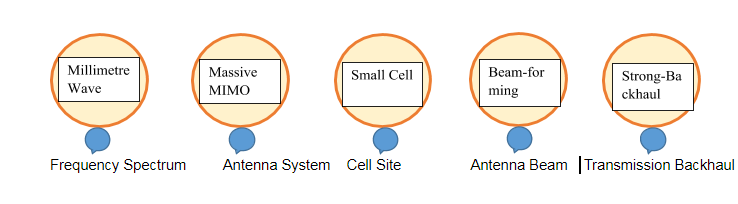
We can say 5 Building blocks of 5G are (but not limited to…)-

Frequency Spectrum-

Frequency band for 5G is in millimetre waves with frequency band 26GHz, 28GHz, 38GHz and 60 GHz.

Allocated lower frequency band from 600 MHz to 6 GHz.

Specially it usage the frequency band 3.5 GHz to 4.2 GHz in this lower frequency band. 

3.5GHz frequency is very important as it is likely to be globally harmonized.

However the speeds in lower band is only moderately high from 4G speed.

Antenna System-

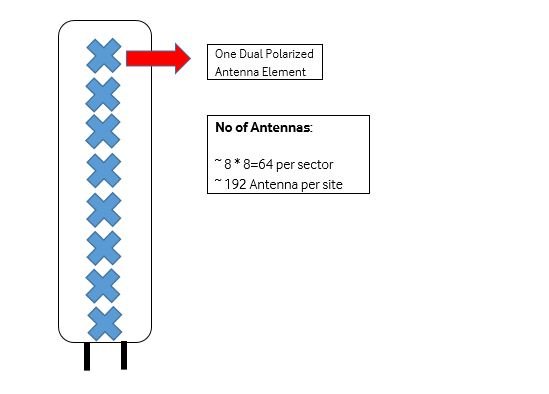
In 5G antenna system is Massive MIMO (Multiple Input Multiple Output) technology where it comprises 64-256 antennas.

If we consider 1 physical antenna contains 8 dual polarized antenna elements and 1 sector usage 8 physical antennas then total antenna per sector would be (8*8=64). So 192 antenna elements per site.

For more details on Massive MIMO you should also read about Massive MIMO here.

Cell Site-

As 5G frequency range is in millimetre waves the absorption of signal is very high by buildings, trees, water and other particles in air.

Penetration of signal would be very low. Coverage distance of a cell site would be very less.

To cover a particular location requirement of no of cell sites will increase. In urban area 1 cell site would cover approximately 200m distance.

So regular macro cell sites (coverage range is approximately 500m to 2 Km for 4G) would be replaced by lot of small cell sites.

Beamforming-

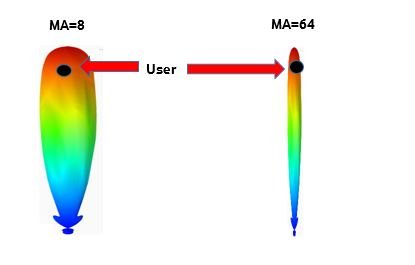
In massive MIMO (multiple input multiple output) technique we use large no of antennas. The beamforming of these antennas are very much directive. So it is almost like serving individual user.

It has a very narrow main lobe, like laser-beam. Side lobes are very tiny. Less leakage in undesired directions.

Array gain of antenna is: 10 log10 (MA), where MA= no of antennas.

Transmission Backhaul-

3G, 4G or 5G, any technology can’t provide expected data speed until and unless we have a strong backhaul connectivity. Connectivity from Core (Switch) to BSC/RNS and finally to the base station (nodeB/enodeB) is the backhaul connectivity.

If we have high capacity backhaul till the BTS end then only we can get a high data speed on air interface between base station and our mobile station.

For 4G and 5G, Fibre backhaul connectivity is a major requirement.  Without Fibre connectivity expecting a speed of 1Gbps or 20Gbps is beyond expectation.

Challenges-

Some major technical challenges of implementation of 5G are-

  • Large space requirement for installation of Massive MIMO antennas.
  • Roll out of huge no of small cells.
  • Readiness of strong backhaul connectivity.

There are many other challenges like acquisition of new locations for small cells, etc.

There are many issues in hand but they all are solvable.

1st 5G deployment country-

The 1st country to launch 5G network is Qatar. Ooredoo a large mobile operator commercially launched 5G network in May 2018 in 3.5Ghz band.

Vodafone Qatar has also launched 5G in August 2018 in 3.5 GHz band.

Thank you for reading so far. You are important for me, please leave your footprint here:

[mc4wp_form id=”173″]

<script async src="https://pagead2.googlesyndication.com/pagead/js/adsbygoogle.js?client=ca-pub-2754967439384345"
     crossorigin="anonymous"></script>