Frame, Sub Frame, Slot, Numerology (Subcarrier Spacing)
The 5G New Radio (NR) frame structure is the arrangement of radio resource elements within a time-frequency grid in the 5G wireless communication system. The frame structure in 5G NR is designed to support various types of communication scenarios and requirements, including different bandwidths, subcarrier spacings, and numerologies.
The 5G NR frame structure consists of multiple hierarchical levels, including radio frames, subframes, and slots, each with its own duration and composition. Here’s an overview of the 5G NR frame structure:
Radio Frame:
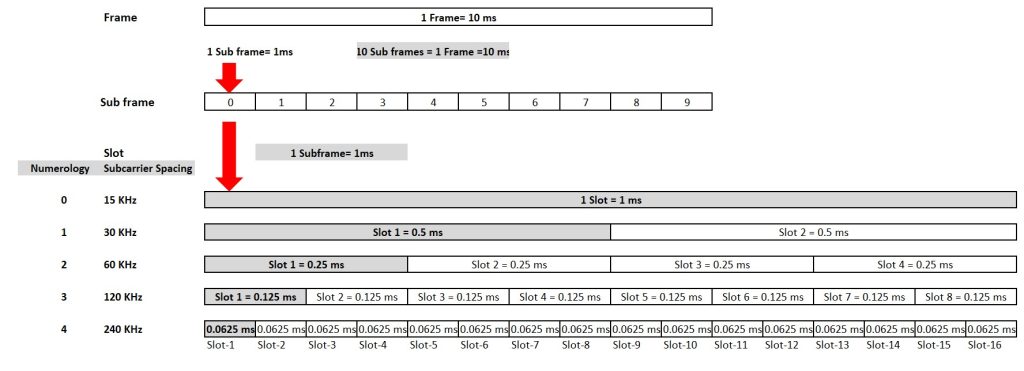
The highest-level structure in the 5G NR frame hierarchy is the radio frame. The radio frame has a duration of 10 milliseconds (ms) and is further divided into 10 subframes. The number of slots in a radio frame depends on the subcarrier spacing and the slot duration.
Subframe:
A radio frame is divided into subframes, each with a duration of 1 millisecond (ms).
Slot:
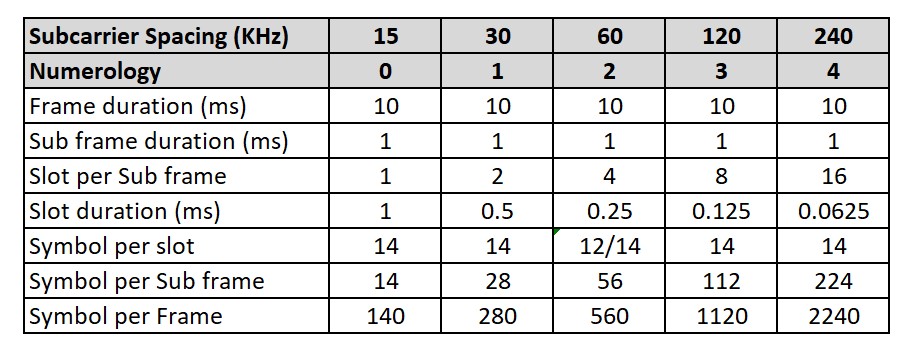
Each subframe is further divided into slots. The number of slots in a subframe depends on the subcarrier spacing. A slot can carry multiple symbols.
Symbol:
A symbol is the basic unit of time within a slot. The number of symbols in a slot depends subcarrier spacing. A symbol carries information in the time and frequency domains.
Resource Blocks:
A resource block (RB) is a group of contiguous subcarriers in the frequency domain and symbols in the time domain. The number of subcarriers and symbols in a resource block depends on the subcarrier spacing and the slot duration.
The 5G NR frame structure is flexible and supports different numerologies, which refer to the subcarrier spacing and time duration configurations. The numerology defines the number of subcarriers per resource block, the number of symbols per slot, and the duration of a slot.
In telecom network Transmission backhaul is
the main Backbone of the network.
Whatever technology we may use 2G, 3G, LTE
or even 5G the main support provided by transmission network only and desired
data speed can only be obtained if we have sufficient available bandwidth in
transmission links.
These transmission links may be:
Microwave
Fibre
VSAT
Or
any other medium.
In telecom network first three types of transmission
medium is mainly used.
VSAT is only used in cases where the target location is very remote and Line of Sight (LOS) is not cleared anyhow.
Additionally installation as well as maintenance cost of VSAT is very high. And available bandwidth is low. So expected bandwidth are usually 512 Kbps or somewhat nearby.
So main transmission medium till 3G network was only Microwave though fibre was preferred for redundancy, path protection and main backhaul connectivity.
When 4G came, fibre become a part and parcel of the network as to get desired data speed of 4G. We need huge bandwidth to support 4G speed.
In 4G it is a combination of Fibre as well as Microwave connectivity.
When 5G will come up as a normal service fibre will play the main role of connectivity.
Transmission Bandwidth Requirement:
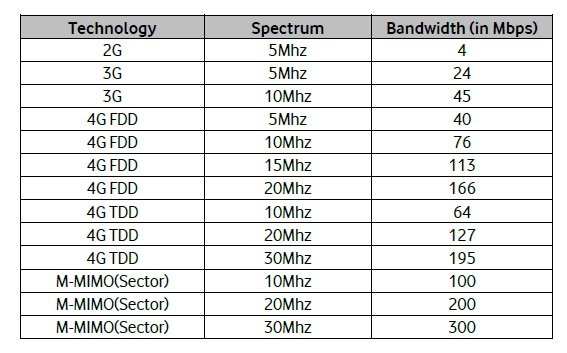
Per site bandwidth requirement based on technology wise and spectrum wise are as below:
TDD & MM coexistence
site:
For a site where TDD and MM
(Massive MIMO) both are present then bandwidth of MM is considered as the
bandwidth of the site.
TDD bandwidth for that
particular site is not added to the MM bandwidth.
More than 1 sector MM site:
For more than 1 sector MM
(Massive MIMO) site, total bandwidth of the site is considered as:
Site
BW= MM Bandwidth of 1 sector * 1.5
We can take the below
examples:
Let’s take 20 MHz bandwidth
scenario for both MM and TDD
Site
with 1 MM sector + 2 TDD sectors:
Site bandwidth will be 200
Mbps.
Site
with 2 MM sectors+ 1 TDD sector:
Site bandwidth will be 300 Mbps.
i.e 200 Mbps of 1 sector of
the MM * 1.5 times.
Site
with 3 MM sectors:
Site bandwidth will be 300
Mbps.
i.e 200 Mbps of 1 sector of
the MM * 1.5 times
Massive MIMO sites required very high backhaul requirement.
So these sites are ideally
planned in fibre pop locations only.
Now we can understand that based on backhaul available bandwidth we can expect data speed on our mobile. Speed is also depends on Technology i.e. 3G, 4G or 5G and their modulation scheme.
If congestion occurs in transmission network, data
speed gets reduced.
These congestion are mainly happens in case of data linked sites i.e. 3G or 4G sites.
So it is very much required to check and do
optimization of the transmission links.
If utilization of a transmission link goes beyond 70% then we should plan to optimize or upgrade the links.
There are mainly 3 different methods we can apply to
upgrade or optimize a link.
Bandwidth up-gradation
Link re-routing
Link equipment up-gradation.
Bandwidth up-gradation:
For IP nodes we can upgrade the available bandwidth of
the microwave links.
Suppose a link is working on available bandwidth of 183 Mbps then we can upgrade it to 214 or 240 Mbps and check if the link utilization is going down or not.
If some links are working below 183 Mbps, then we can
upgrade those links to 183 Mbps.
Only problem in upgradation of bandwidth is that with new bandwidth if we run link budget in some cases it may shows loss of availability of the link.
If this problem occurs then we should not prefer
bandwidth upgradation.
This problem occurs because, with bandwidth increase we have to also increase power.
If power is already in maximum, then this may give a low receive level at the receiver end.
Advantageofbandwidth upgradation is that no additional cost involved and less time consuming. If link budget in planning tool works perfect then we can immediately implement the same in the system.
Link re-route Engineering:
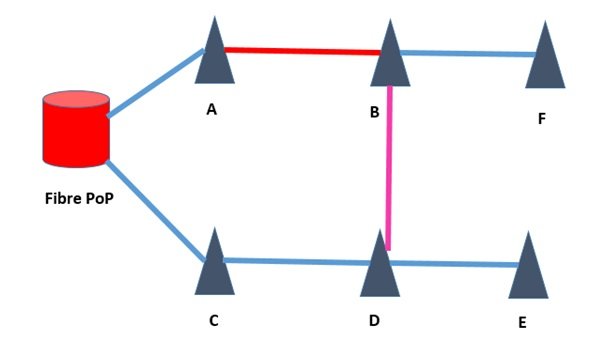
We take an example of the above figure as a part of our network.
In the above figure “A” to “F” are Base stations (BTS). Serving route of F is in the direction from Fiber pop up to BTS location “F”. The physical route of serving E1 is “Fibre PoP-A-B-F”.
Link “A-B”is congested and bandwidth upgradation can’t be done. This link is carried traffic of nodeB (3G)/enodeB(4G) “B” as well as nodeB(3G)/enodeB(4G) “F”.
Remaining all other links are not highly utilized.
So if we reroute path of “F” then congestion level may goes down in the link between “A-B”.
Here we can make a new route in the direction “Fibre PoP-C-D-B-F”.
This is a very simple case we are considering here for ease of understanding.
Main issue in such type of activity is that once we route “F” through new route “Fibre PoP-C-D-B-F” there may be chances that any link of this route may get congested.
So, for that, before making a new route we have to check each link of the new route whether they are able to handle new traffic of “F” or not.
If not then there is no meaning of doing of all these rerouting activities and plan for some other alternatives.
Link equipment up-gradation
Third option is link equipment upgradation.
We can replace the MW hop with XPIC (Cross Polarization) hop.
This will double the capacity of the link.
If the congested link is already a XPIC hop then we may plan for some new fibre PoP.
XPIC upgradation and Fibre PoP plan both have cost
involvement.
So this is the last option we choose if all other
possibilities failed.
Summary:
Once we have noticed any link utilization greater than
70% we plan for any of the three methods that we discussed above.
Transmission Link should have enough available
bandwidth in 3G, 4G and 5G network to get desired data speed.
Thanks for reading this blog.
Your feedback, comments, suggestions or like are
highly appreciated.
In Telecom network it is very often required to do the
calculation for the network capacity.
This capacity is mainly required to do an analysis of
the utilization of the network.
What is the current capacity of the network and what
is the status of current utilization of the resources.
In 2G, 3G and 4G (LTE) in all cases we need to find
out capacity of Voice (only for 2G) and Data (Especially for 3G & 4G).
The methods we are going to discuss can be used to do
the calculation before implementation of a network or in existing network.
Here we emphasise mainly to do the capacity calculation for an existing network.
1. Voice Capacity Calculation (2G Network):
Voice
capacity calculation of a site is an old method and most of us are already know
it.
Here
what we do, we do the capacity calculation sector wise, and then add up the
sector values to get site wise total erlang capacity.
Now
take the formula to do the calculation.
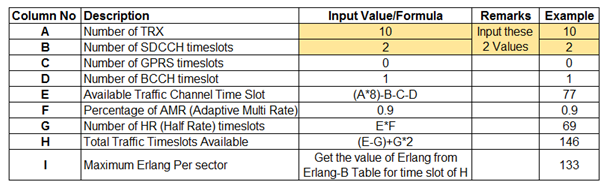
Formula for 1 Sector:
This is a calculation for 1 sector. The column names
mentioned in the table to simplify the formula.
This is a calculation considering HALF RATE (HR) and with Adaptive Multi Rate (AMR).
If we work for FULL
RATE (FR) then we can ignore the columns F, G and H.
Get the Erlang value w.r.t. the timeslot in column E
from Erlang-B table.
Calculation
for the whole Network:
If we have 5000 2G sites in our Network (Just taking a
random example) then we have to sum up the erlang values of all the sectors.
That will become the complete Erlang
(Voice) Capacity or Equipped
Erlang of the network.
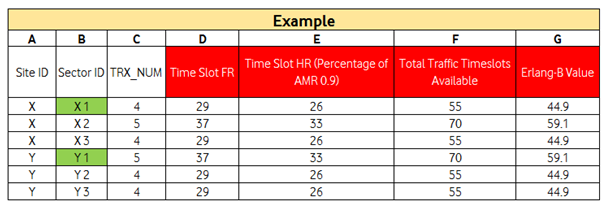
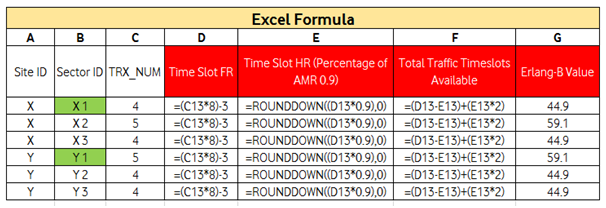
Table: 1
Table: 2
This
is an example of 2 sites each with 3 sectors. Likewise we can do the
calculation for all the sectors of the network and finally sum up the column
“G”. That will become the Erlang
Capacity, Voice Capacity or Equipped
Erlang of the existing network.
After
getting this Capacity now it is easy to find out utilization of sites. We need
to take the traffic data (Cell wise/Site wise) from system generated data and
just divide Traffic by Capacity.
There
is a report which gives Voice and
data capacity of the network.
But sometimes the problem with the report is that, if in any case there are some sites which are down/hold due to some technical /Non-technical issue, capacity of those sites are not considered in the report.
2.Data Capacity Calculation (3G& LTE Network):
Data capacity of a site mainly depends on the
available Bandwidth of the site.
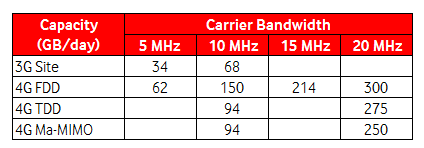
Based on available Bandwidth below is the table which
shows the maximum capacity of a site.
This value may change slightly case to case basis, but
we consider these values as maximum capacity of a site for any calculation
purpose.
Table: 3
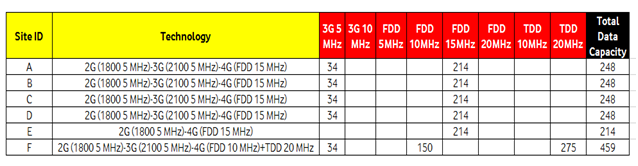
Now we can see the below mentioned 6 sites.
Based on site wise technology and bandwidth we will
get a total data capacity of a site.
This total data capacity of the whole network can be
summed up to get the Data Capacity for the whole network, which may contains
any no of sites.
This bandwidth wise data capacity is independent of
frequency band.
For 10 MHz band we will get same 150 GB/site/day for
1800 band or 2100 band 4G sites.
Similar scenario for all other cases too.
Table: 4
Here we are not considering any data for 2G is because
2G data capacity is very low and it is based on the allocation of time slots
for EDGE.
Moreover here we should not confused between data speed
and data capacity. Here we are discussing only about data capacity of a site
not anything about data speed or throughput.
Speed/Throughput altogether is a different concept and
we may discuss in a separate blog.
Utilization:
Again for utilization as we did for 2G traffic. Here
we have to find the actual site wise used payload and divide this value with
the total data capacity.
This may be done site wise or for the whole network.
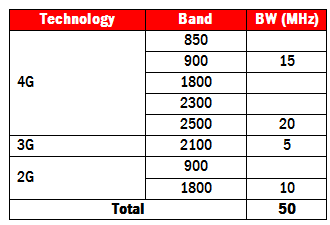
Here we are considering any telecom circle having the
below mentioned frequency band along with allocated bandwidth.
These figures we are taking just as an example.
Frequency band and allocated bandwidth may vary based
on telecom circle.
Table: 5
From the above table it is found that for a telecom
circle “X” we have total 50MHz bandwidth.
In 4G total
35 MHz (900 band 15 MHz and 2500-TDD band 20 MHz).
Similarly for 3G
in 2100 MHz band 5 MHz, and for 2G
total 10 MHz in 1800 MHz band.
In this case for calculating site wise bandwidth first
of all we have to find out site wise technology.
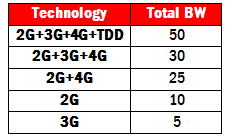
In a single site there may be any combination of
technology.
For example we are considering the below mentioned
technology combinations in any site and corresponding site bandwidth.
Table: 6
These technology combinations in a site may vary as
per requirement.
Calculation
for the whole Network (Data & Bandwidth)
In this way we can find site wise total bandwidth.
Once we get site wise data
and bandwidth now we can do all types of permutation combination.
Like District wise, state wise, town wise requirement
of data for capacity and Utilization calculation.
Showing of Bandwidth utilization is bit different from
all other cases. Suppose we need district wise or town wise or may be any
category wise Bandwidth utilization. In that case we can’t do the same
calculation as like voice and data.
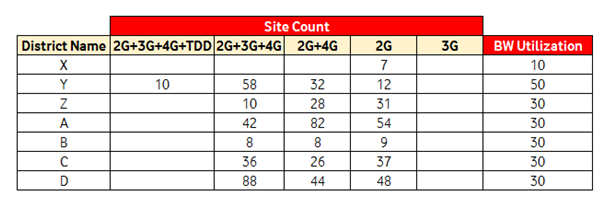
Please check the below mentioned table:
Table:7
If in a district named “X” has only 2G sites (here in this example showing 2G sites) then bandwidth utilization in that district will be 10 (refer Table:5,6 & 7)
In district “Y” there are 10 sites which are having
all 2G+3G+4G+TDD technology.
So bandwidth utilization will be sum of all technologies i.e. 50 MHz (refer Table:5,6 & 7).
In district “Y” there may be other different
technology sites too. Like 2G+4G 32 sites.
But we do not require considering utilization of
district “Y” as 50+35. Instead it would be only 50.
Similar cases for all other combinations too.
Summary:
In telecom network capacity and utilization
calculation is required to do very often.
As technology changes i.e. upgraded from 2G to 3G or
4G or may be site is loaded with TDD whole calculation for a particular site
will be changed.
So this is an ongoing and necessary process to have an overall idea of the whole network.
Thanks for reading this blog.
Your feedback, comments, suggestions or like are highly appreciated.
Coverage, Infill, Capacity, In-building Solution, Small Cell, Femto Cell and Repeater
Today
we are going to discuss about different types of Cell site in telecom field.
These
cell sites can be used in 2G, 3G, 4G or 5G technologies.
There
are seven types of cell site or solution we can have to provide network
coverage and capacity.
They
are:
Coverage site.
Infill Site.
Capacity Site.
Samll Cell.
Femto Cell.
In-Building Solution (IBS)
Repeater.
Out
of all these, we know most of the things about coverage, Infill and capacity sites
and repeater.
But Small cell, Femto cell are some new concept those are coming along with 4G and 5G technology.
1.Coverage / New Site
A
location where Operator-A does not have any coverage and planning to expand its
coverage in that particular location then this type of site/sites are called
Coverage site.
In
that particular area customers will get Operator-A network for the 1st
time.
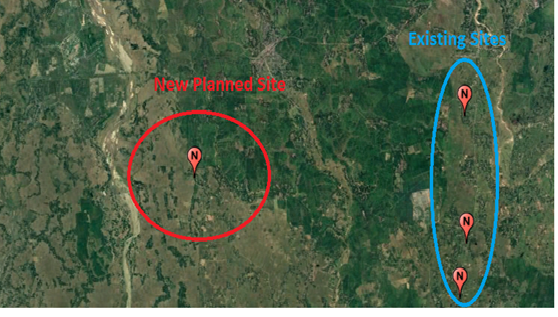
The coverage distance of a capacity site is as much as possible so that it can cover maximum distance.
Basic Planning Part of Coverage Site:
1800 MHz Band:
Usually
coverage sites are planned based on frequency band.
If
we are using 1800MHz band then in ideal condition 1800MHz site can give coverage
up to 2.5Km.
So
we prefer a site which is not coming within 2 to 2.5 Km rang of an existing
site.
This
concept is not always applicable especially in case of Dense Urban, Urban, and
Semi-Urban area.
Because
in such kind of area due to high rise and congested buildings indoor coverage
issue is always seen.
So
in such type of area we may plan coverage sites for the first time within 1 Km
or even 500m or may be less based on clutter density and terrain conditions.
900 MHz Band:
In
case of 900 MHz the coverage range of a site may goes up to 4 Km.
So
in that case we should not prefer a new site below 3.5 Km from an existing
site.
Highway:
On
highway sites the distance between the sites are kept at a greater distance
than normal sites, as at highway sites we generally use comparatively high gain
antenna than normal sites.
High gain antenna gives a long distance coverage e.g. like 4 Km gap for 1800 MHz band.
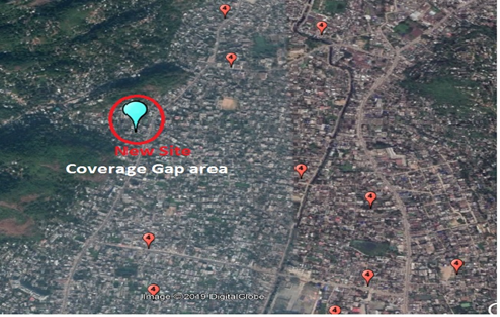
2.Infill Site:
In
a location, suppose a in a town name X, Operator-A already has coverage either
with one site or may be 2, 3 or more sites (for bigger town).
But
inside the town or location there are some places where there is some coverage
gap or black holes of coverage and the existing sites are unable to provide
proper coverage in those particular locations.
In
such cases we plan new site specially to remove coverage gap inside a town or a
location.
These sites are called Infill site.
Infill
sites are planned to cover a distance up to 500-700m or may be up to 1Km based
on coverage gap and the location where we want to provide network coverage.
Coverage
distance of infill sites is totally based on the area where we want to mitigate
the coverage gap.
For
a dense city with hilly terrain we may plan a new infill site even at a
distance of 100m from exiting tower. But for a same kind of dense city with
plain terrain we may prefer a new site beyond 300-500m from existing site.
In case of Infill site, site optimization is done properly so that we should not face the problem of interference of nearby site as well as coverage overlapping.
3.Capacity Site:
Suppose
in a location there are 3, 4 sites or any no of sites and provide good coverage
in the whole town.
There
is no coverage gap in any place. But sites are over loaded. All or may be one,two
sites or may be 2, 3 sectors of the town are highly congested and we can’t add
any more capacity to that site.
In
such scenario we plan some new sites to off load the congested cells.
This type of site is called Capacity Site.
Basic Planning Part of Capacity Site:
2G:
Earlier
when we have only 2G technology and if traffic for a particular site increasing
day by day and equipped capacity of that sites is more than 160% utilized then
we planned for TRX addition.
If
TRX addition reached to a level of exhaustion based on the BTS capacity then we
plan for a new site nearby to offload 1 or 2 sectors of that site.
TRX
handling capacity is depends on the type of BTS we are using.
Suppose
if we use a Nokia ULTRA BTS (which is obsolete now a days) then it can handle
only 12 TRX (4/4/4). If we want to increase TRX capacity at a ULTRA BTS site
then we need to install 1 more BTS box to support additional TRXs.
If
we use Nokia BTS like Flexi Edge then additional hardware not required, only
software upgradation required.
But
whatever the upgradation capacity (TRX capacity) of a BTS, it also depends on the
available bandwidth of 2G.
3G & 4G:
4G
VoLTE (voice over LTE) is totally based on packet switched concept i.e. only
data. No circuit switching.
In
case of 3G, though voice traffic is handled by circuit switching, still as 3G
is going to become obsolete very soon operator are not much concern about
increasing 3G capacity at site.
Gradually
3G layers will be converted to 4G layer on the same frequency band.
Equipment
for 3G and 4G will be almost same except we have to replace the 3G baseband (a
card inside the BTS) with a new 4G baseband.
No
need to replace antenna and Radio unit. But sometimes based on the 4G
compatibility of Radio unit (RRU) we may need to replace the existing 3G RRU
with new 4G RRU.
But
this is not applicable for all cases.
How
to convert a 3G layer to a 4G layer in same frequency band of 3G we will
discussed in my upcoming blog in details.
Alternate Options of Capacity Site:
Now
a days we avoid to implement or integrate capacity sites.
Currently
the main concern is with data rather than voice traffic. As we have now 3G and
4G both technologies over and above 2G.
In
Case of 4G we don’t prefer a capacity site to offload one or 2 sectors of an
existing 4G site.
In
4G we have so many alternate options.
If
payload of a site increases we can take any of the below mentioned steps.
Option 1- Bandwidth Expansion:
Considering
existing 4G site is operating at 1800MHz band FDD and in 5MHz.
Then
we can upgrade it to
10 MHz band
15 MHz band
20 MHz band
And
even beyond 20MHz also provided the operator has a continuous frequency band of
20MHz or beyond.
For
that we need to take only software licenses. No need to do any changes in
hardware part.
Option 2- TDD Site:
Going
for a TDD (Time Division Duplexing) site at the same location.
If
we have 2500 MHz or 2300 MHz TDD frequency band then we add equipment of the
respective band at the same sites.
Equipment
will include Antenna, Radio and baseband unit.
Addition
of TDD layer will increase the data handling capacity of that site.
Even
in TDD also we have options to increase our bandwidth of sites, suppose from
10MHz to 20 MHz, based on availability of frequency band of the Operator.
Putting a new technology like TDD on
existing FDD site or bandwidth expansion is cheaper compared to installation of
a new site.
Option 3- Small Cell:
And
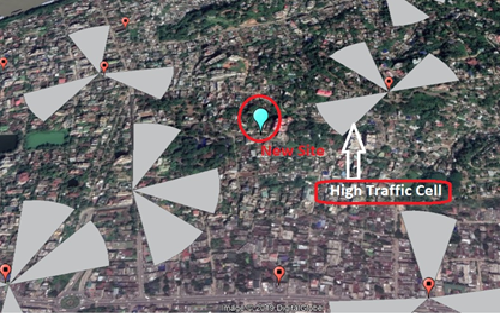
the last option for increasing the capacity of a 4G or 5G site is Small Cell.
So now a days capacity site planning is not preferred until and unless all above mentioned attempts fail to handle the carried traffic/payload of the site.
4.In-Building Solution (IBS)
In
Building Solution (IBS) is to provide coverage inside a building and in each
floor.
Here
there is a MACO BTS like any other normal site. We can use 1 or 2 sectors as
Outdoor site as normal site and 1 sector can be used only for Indoor coverage
purpose.
That
sector will serve lots of small indoor antennas in each floor.
In
some cases we don’t use any outdoor sector to provide coverage outside the
building.
This
type of site is installed in big hotels or large complex.
In all above discussed cases, we use MACRO BTSs.
Now
we come to discussion of all new kind of BTSs or solutions based on different
requirement.
The new cell concept that now we are going to discuss is about Samll Cell, Femto Cell and Repeater are some solutions for the coverage and capacity requirements for the hotspot locations, enterprise accounts and high values subscribers.
5.Small Cell:
There are broadly three types of solutions namely
Outdoor
Small Cell
Residential
Small Cell.
Enterprise Small Cell.
Here we are discussing only about types of small cell. We will
discuss in details about small cell in a separate blog.
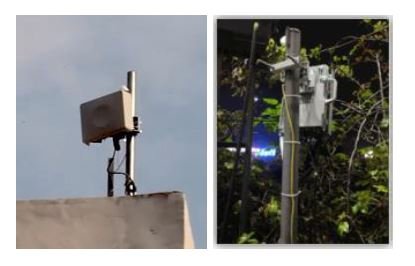
Outdoor Small Cells:
To
meet coverage and capacity requirements at Hot spot or small area coverage requirement,
outdoor small cell is solution for such requirement. It is IP65 and consumes
low power. The unit can be mounted on walls, poles or masts. This is all in one
(AiO) solution need AC power supply and backhaul connectivity to integrate.
In 5G only small cell concept is used. Its coverage distance is 50 to 100m. So lot of cell site will be required if we plan to provide 5G in a particular area.
Camouflage Outdoor Small Cell
Below
is the example of a camouflaged outdoor small cell.
It was installed in a restaurant with garden outside. In that garden this small cell was camouflaged like a coconut tree.
Residential Small Cells:
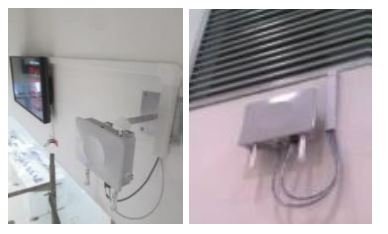
Residential indoor small cells solution is for hot spots as
the complementary coverage and capacity solution. It can be used in Small
Office Home Office (SOHO), SME (Small and Medium Enterprise), government
offices, stations, entertainment places, hotels and airports etc.
It
is a small and light all-in-one system which integrated baseband and radio
modules. It can be flexibly installed in many places such as on the desk, on
the wall or under the ceiling. It
Aims
to provide ultra-high-speed data services especially for hot spots or poor/no
coverage area as a supplemental of macro base station. This is also all in one
(AiO) solution need AC/DC power supply and backhaul connectivity to integrate.
This type of small cell we usually plan to give better coverage and capacity at the Stores owned by the Operator itself.
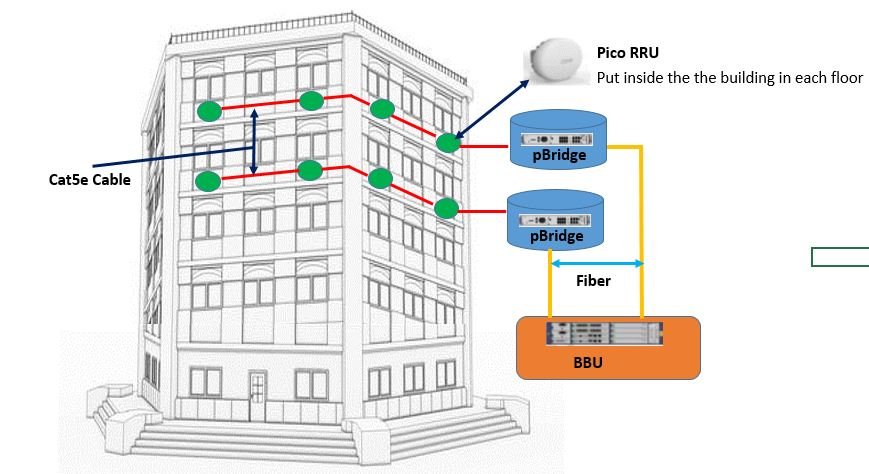
Enterprise Small Cells:
To full fill unprecedented amount of mobile broadband capacity inside buildings enterprise small cell is the solution. This is the solution to multiflorous commercial building.
It involves floor wise planning and deployment of radios with hub devise and baseband. Enterprise small cells can be used at retail stores, branch offices, corporate headquarters and university campuses etc.
6.Femto Cells:
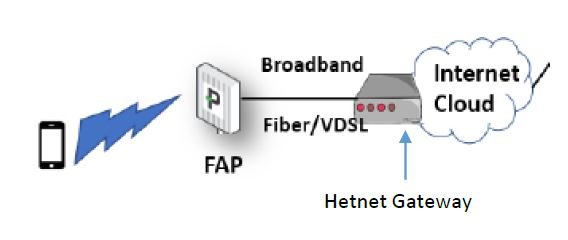
Femto solution is similar to small cell indoor solution, suitable for residential, enterprise deployments. It provides backhaul flexibility from traditional Optical or Ethernet to any IP public or private backhaul and make this solution easy to deploy.
Apart from backhaul Hetnet gateway also required which is for security and IPsec tunnelling purpose.
7.Digital Repeaters:
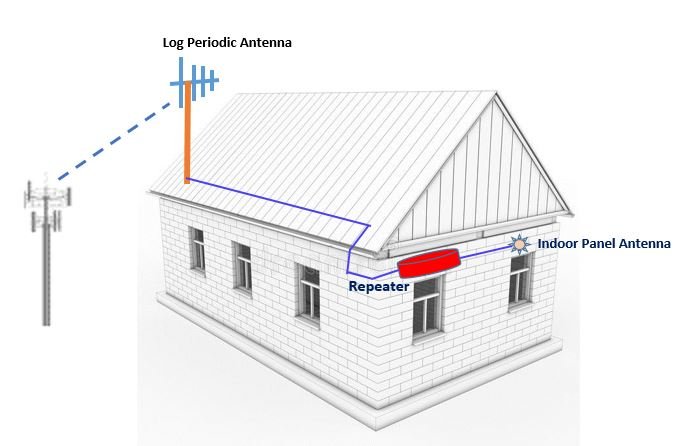
Digital repeaters amplify weak signal and provide coverage in deep indoor or poor signal areas, these devices can be used to provide coverage in indoor residential building or small commercial buildings or specific floor of multistory building.
Digital repeaters do not actively involve radio devices to generate signals, these repeaters are also knows as signal boosters. Outdoor repeaters are also available in high power range.
These devices boosts specific band signal and assigned sub bands. These are coverage solution and do not contribute in capacity.
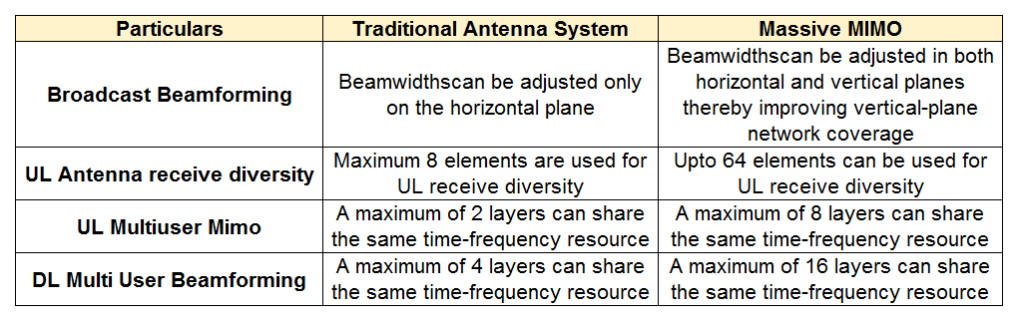
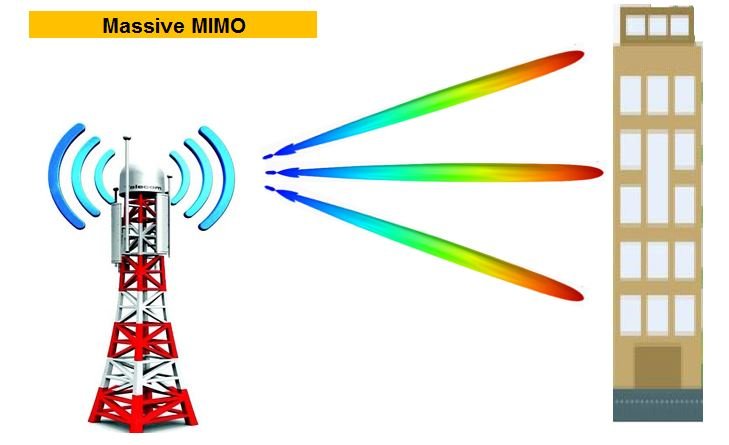
Massive
MIMO is a key update of multiple-antenna technology.
It
uses large no of antenna arrays.
Performs
3D beamforming and multi-user multiplexing.
Significantly improves system capacity.
In
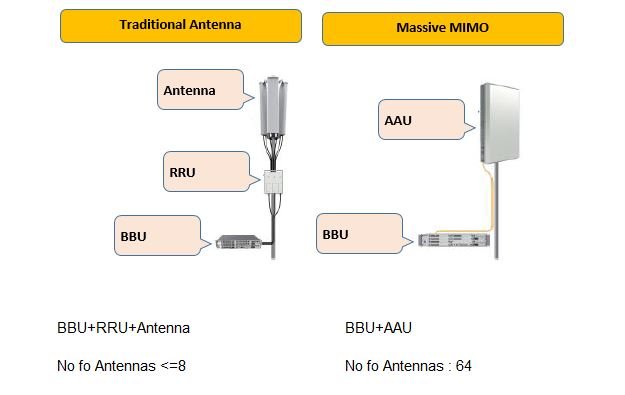
Massive MIMO an antenna Module named AAU is used.
AAU
is Active Antenna Unit that has both Antenna and Radio Frequency Functions.
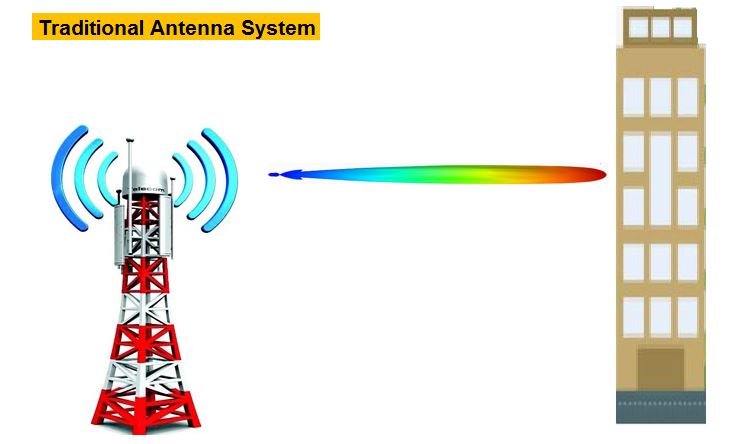
In
traditional antenna system we have to use separate Radio function unit and
antennas.
Comparison Traditional Antenna System and Massive MIMO:
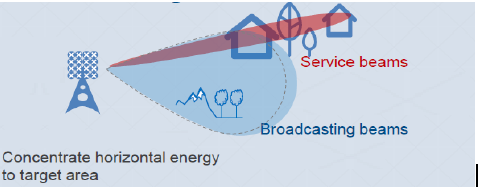
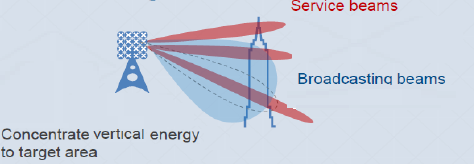
We
can have a pictorial view of Horizontal as well as Vertical coverage scenario
of Massive MIMO for better understanding.
Horizontal Coverage Scenario:
Vertical Coverage Scenario:
Benefits of Massive MIMO:
Massive MIMO improves cell capacity and Coverage
Increase User Experience.
Encourage Data Speed.
Application Area of Massive MIMO:
Squares, Stadiums and Big events:
Precise User specific beams
Effective Interference Control
CBD Skyscrapers:
3D MIMO for high floor coverage.
Stations, Shopping Malls:
Concentrate user energy to combat propagation and penetration loss.
Dense Residential, Universities:
Multi user MIMO to increase Cell capacity.
Main
Aim of using Massive MIMO are:
Hotspot Coverage:
In
Hotspot area user density is very high. Demand of data is also very high. In
such scenario Massive MIMO can improve system capacity through spatial
multiplexing.
By
using Massive MIMO cell throughput increases and thus meet capacity demands in
hotspot areas.
Tall Building Coverage:
With
traditional site coverage in Tall buildings can’t satisfy as approximately
vertical beam width is 7 degree.
With Massive MIMO 35 degree Vertical beam width can be achieved to cover tall buildings.
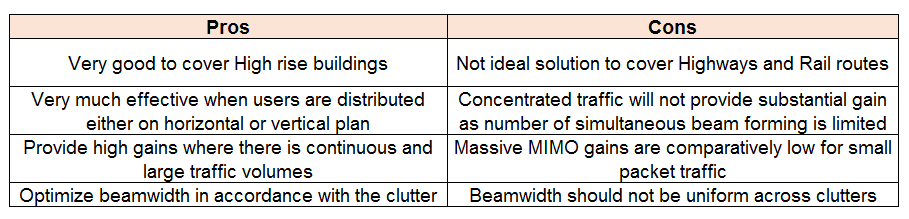
Pros and Cons of Massive MIMO:
Conclusion:
I had introduced Massive MIMO technology in my earlier blog 5G Introduction where I have mentioned that Massive MIMO is one of the 5 building Blocks of 5G.
It
does not mean we have to use Massive MIMO in 5G only.
We use Massive MIMO in LTE as well as 5G technology for better data handling and improved capacity.
How Massive MIMO plays a vital role in 5G you should also read blog on
Once
Continuous Wave (CW) testing is over and we are having required samples of
field data then next step of Network/ RF planning is Model Tuning.
In
this blog we will discuss how we do Model Tuning in Atoll or other Planning
Tool.
This
blog contains basic theory of Model Tuning and finally steps involved to do the
Model Tuning in Planning Tool.
Emphasize on to understand Model Tuning in a very simpler way through step by step approach of doing it in a Planning Tool like Atoll.
If you still not going through my earlier blog on CW testing you should read it here, before going to Model Tuning phase.
Basic Understanding of Model Tuning
1st
of all we should understand the basic of Model tuning, why do we do Model
Tuning.
In
simple language Model Tuning is done to match the coverage distance of
transmitted signal, in field and in Planning Tool for the same frequency and for
similar kind of terrain and clutter.
Suppose
in field we have seen through our CW testing samples that in 2100MHz in a
particular Urban area Received Signal Level (-93dBm) can travel a distance of
500m.
Now
our target is to set this 500m distance (for signal level -93dBm) in Planning
Tool for a site which operates in 2100 MHz Band in similar Urban clutter.
Here
I am considering the same example as in Continuous Wave Testing (CW Testing)
blog.
Once
Model Tuning is completed, a propagation Model is set and all future coverage
prediction will be done based on the DESIGNED MODEL for a network.
Model will be differently set for 2G, 3G, 4G-LTE or even for 5G based on use of different frequency band and Modulation techniques.
Propagation Model and Formula:
There
are different types of Propagation Model based on different terrain and
frequency range.
Widely
used Propagation Models are Okumura-Hata Propagation Model, Cost-Hata
Propagation Model, ITU-529-3 Propagation Model and so on.
Different
Model has different characteristics.
The
Standard Propagation Model is a Propagation Model based on Hata Formula and is suited for predictions in 150 to 3500 MHz band
over long distance (from one to 20Km).
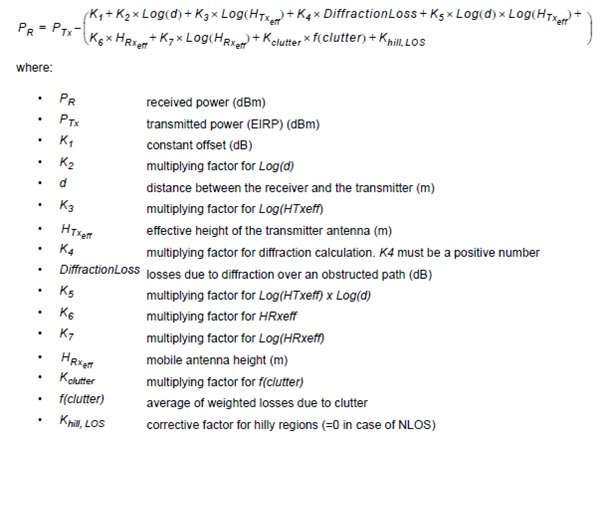
Formula for Standard Propagation
Model:
Before seeing the formula just remember one thing, formula may be complicated but the actual process of doing it practically, is not that much complicated. It is simple. We should not bother much about formula. But before doing something at least we should know the theory why we are doing all these activities.
Though
this formula contains lot of factors, but almost all factors are known to us.
E.g.
We know Transmitted power how much we will transmit from a transmitter.
Htx
is height of the transmitter i.e. the Mobile Tower (Antenna Height e.g. 30m,40m
etc.)
Hrx
is Height of receiver i.e. height of a human (UE) generally considered 1.5m and
like this.
Main
3 factors that we don’t know is K1
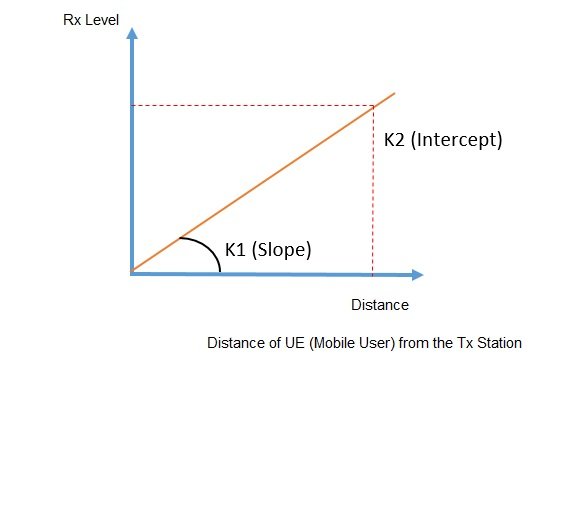
(Slope), K2 (Intercept) and D (Distance) between transmitter and
Receiver.
It
makes a plot called Regression Curve where we take the Standard Deviation
value.
X-axis for the plot is Distance and Y-axis is
Received Level (Rx Level).
Regression Curve
This
curve is not exactly a straight line. Our main activity is to set different
values for K1, and K2 to meet this kind of approximately
straight line curve.
Setting of K Values:
So
whole Model tuning is done by varying the values of K1 and K2 to get a
required Model.
We
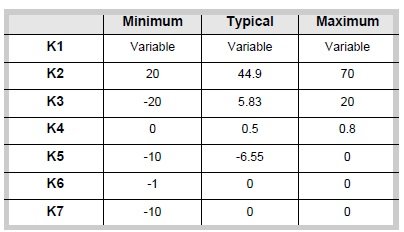
can do variations in other K values
also for up to K7. But usually we
prefer to change K1 and K2 values only.
Setting
of K1 and K2 to get a final Model is totally a trial and error method.
Once
in the Planning Tool, the required distance get covered (from the above
mentioned example, e.g. 500m) for a particular frequency band (e.g. 2100 MHz
band) in a particular clutter (e.g. Urban) for a particular received level (-93
dBm) then Model Tuning of one clutter (In this case Urban) is completed.
Same
process will be repeated for other clutter also like Dense Urban or Rural. Only
difference is based on clutter the travel distance of -93dBms signal will
increase or decrease from 500m.
E.g.
this distance will increase to 1.5Km in case of Rural instead of 500m in Urban.
Process of Doing Model Tuning:
Before
start doing setting of K values we have to create different Projects in the
Planning tool for different Technology.
Separate
Projects required creating for 2G, 3G,
4G-LTE or for 5G.
In
each projects different parameters set for different technology.
E.g.
Modulation techniques will be different for GSM, UMTS, LTE and 5G.
Suppose
2 technologies operates in same frequency band, e.g. in 1800 MHz band we are
operating both 2G and 4G.
In
this case though both technologies are operating in the same frequency band,
yet their modulation technique will be different.
So
the planning tool will do the coverage prediction based on their defined
project and though both are in same band still the coverage distance for same
signal strength will be different.
Sample Types:
Samples through CW Testing:
In
conventional CW testing collected samples shows only the Carrier Signal
Strength.
These
are unmodulated signals. It contains only RX Power and Latitude & Longitude
of sample collected locations.
With
these samples we can’t differentiate technologies. It will give same details
for 1800MHz band regardless of 2G or 4G.
Samples through existing SIM:
If
we collect samples through a SIM of any existing network, collected samples are
modulated signals.
So
we will get a difference of coverage in collected samples for same frequency
band but for different technology.
In
our case suppose 1800MHz band for 2G and 4G same signal level but different
travel distance.
Step by step process:
Data/ Samples collected
through conventional CW testing or through Drive Test (with Existing SIM) are
imported in Planning Tool like Atoll.
We can import the same in other planning tools too.
Let’s see 1 sample data as we mentioned in CW testing.
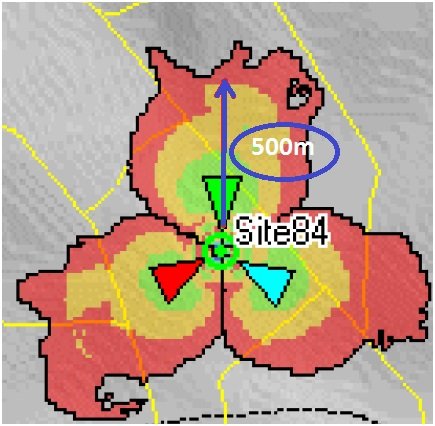
Here we have seen that a signal level of -93 dBm is travelling to a distance of 500m in an Urban area (Say Frequency band 2100MHz for 3G).
Now we have plot a site in Atoll Planning Tool at the same Latitude and Longitude where we set our Transmitter/Mobile Tower during CW testing.
We already made a Project for 3G in Atoll with all different parameters. Main difference of Parameter will be Modulation Techniques for different Technology.
So now Atoll itself has some “K” values for the created Project.
Run a prediction for the sample site by selecting only 1 site.
The tool will show its own coverage area for the site based on the data available in the Project.
This prediction value may or may not match with the actual data we have collected in field.
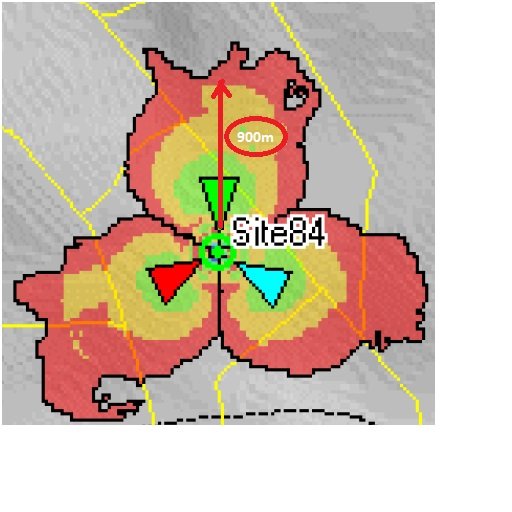
In Planning tool let us define 3 signal level category
Green: -72 dBm
Yellow: -72 to -93 dBm
Red: -93 to -120 dBm
In Tool we can define any no of Signal Level category based
on our requirement.
For simplicity here we are ignoring the GREEN level and will
consider YELLOW for -93 dBm.
And also keeping the 3 sectors of the site in 0/120/240
degree.
For example we consider
that the prediction given by planning tool shows that -93 dBm signal i.e.
YELLOW travels up to 900m distance.
Now our main task is to
change the “K” values mainly K1 and K2 until we reduced the distance of -93dBm signal from 900m
to 500m for this particular site.
Sample
Values for K:
Some Possible values of K are-
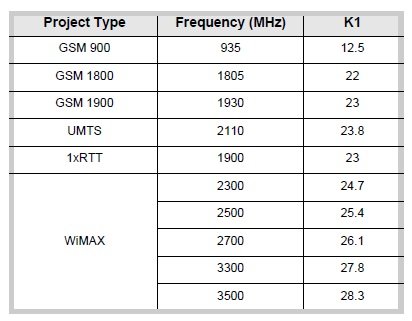
K1 Value is depends upon Radio Frequency and Radio Technology:
Changing of K values are not like 1 time activity.
It is a trial and error
method.
We would vary the “K” values until we reach the value of
500m distance coverage for -93 dBm signal.
Every time after setting
new “K” values we will run a
Prediction Coverage.
Then will check what the
travel distance is.
This Process will be repeated
until we find some “K” values which
shows a prediction of 2100MHz band, signal level -93dBm is covering up to a
maximum distance of 500m.
These values like 500m,
-93dBm will be as per our requirement. These are not some specific values.
These are taken here just for example purpose only. E.g. for
dense Urban 500m will change to 300m.
So accordingly we will do all “K” value settings so that -93dBm (or -73 dBm as per our
requirement) signal level would travel up to 300m only.
So by repeating the process of “K”
value change we can finally reach to a DESIGN in Tool where coverage of signal
level is same both in actual field and also in Planning Tool.
This
is MODEL TUNING.
Once
one design is done for a clutter (in this example Urban) we will do the same process for all other different clutters
i.e. Dense Urban, Semi Urban and Rural.
When
DESIGN is completed for all types of clutter the Model Tuning for the whole
Network is completed.
Now
we can put “n” no of sites in the tool defining which sites will fall in which
clutter type (Urban, Rural etc.). The Tool will give an appropriate coverage
for the whole Network.
So
now we can plan how many sites will be required to cover a particular town or
area based on the prediction plot.
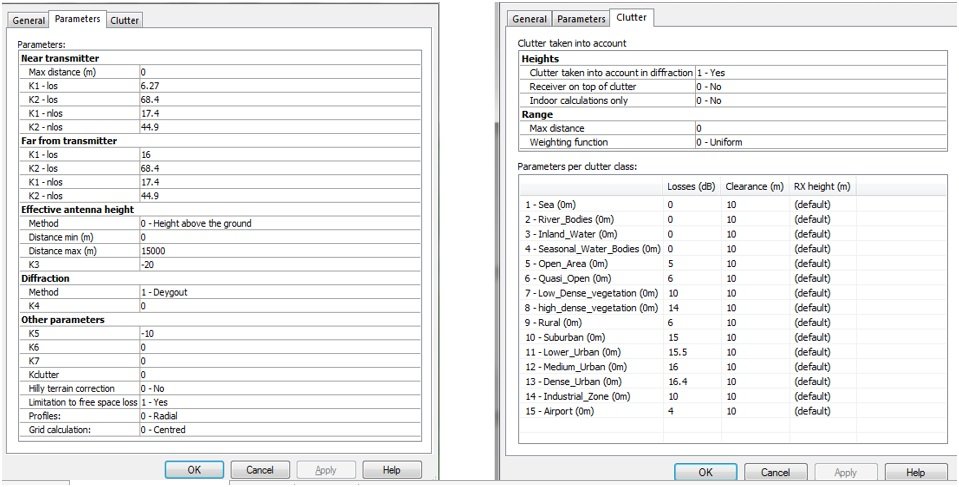
Here is a sample setting of Clutter and Parameters for a Design of 2100MHz 3G in Urban area:
I am not saying that this is an ideal / correct setting for 3G- 2100 MHz band in urban area.
This
is one example I did during my 3G Greenfield project to get the required
design.
In
a separate article we will discuss another method of Model Tuning for an existing Network with the help of MRR report.
Do
you think there are some points I missed here? Leave a comment below.
CW
testing is the First Phase of Telecom/Mobile Network/Radio Frequency (RF)
Planning.
Network
Planning/ RF Planning is always start with Continuous Wave Testing Method for
all GREENFIELD project.
The
main aim of doing CW testing is to gather information to design a propagation
model of transmitted signal for mobile communication.
It
is carried out to gather actual propagation of mobile signals in different
terrain and clutter.
Basic
of doing this test is to measure or to know the actual distance, a transmitted
signal would travel from a Mobile Base Station that we simply say MOBILE TOWER
or SITE.
Propagation
Model primarily depends on geography and terrain of a circle.
Secondly
it also depends on clutter type e.g. Dense Urban (High rise congested
buildings), Urban or Rural area.
This
is the traditional method and best method for Model Tuning/Model designing.
This
is applicable for all technologies that may be 2G, 3G, LTE or 5G. It is mainly
Spectrum dependent test.
With
the help of CW testing and Model tuning we can design a model for our network
to generate coverage prediction and network planning.
Quality
of any network depends on the accuracy of the Propagation Model designed based
on CW testing and Model Tuning.
Basic concept of CW testing is very
simple-
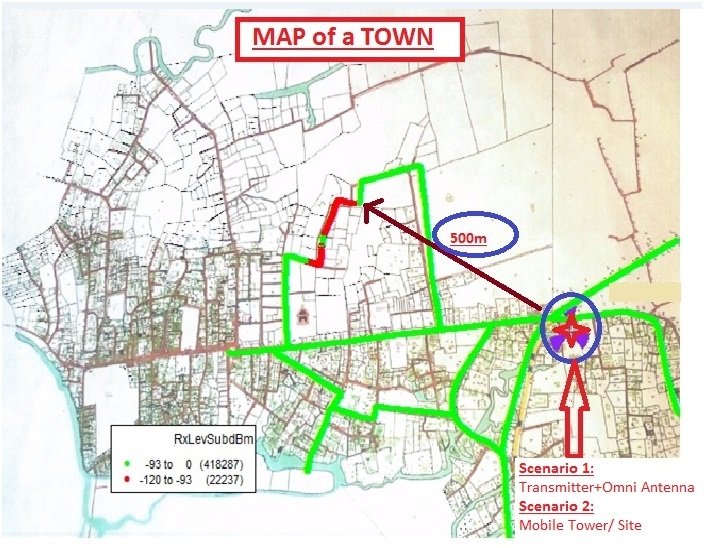
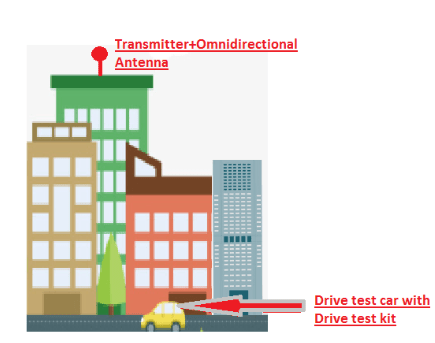
It has one transmitter along with Omnidirectional antenna which will transmit frequency of corresponding licensed frequency (e.g. 1800Mhz, 900MHz band)
A receiver (Drive test kit) will move around the transmitter and checked for signal strength. How far the Receiver can receive signal from the static transmitter.
Set up of CW Testing:
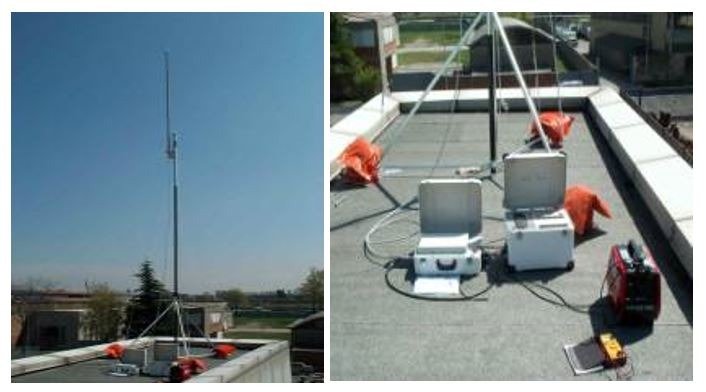
The CW testing equipment contains-
Transmitter
Omnidirectional Antenna.
Power supply to provide
power to the transmitter.
Drive test Kit as a
receiver.
Now
there are two Scenarios for CW Testing.
Scenario-1:
Suppose
in a telecom circle or LSA (usually a state e.g. Assam Circle, Maharashtra
Circle) there is no Operator is having a new technology (e.g. 4G-LTE or 5G)
When
we are planning to start this new technology (e.g. 4G-LTE or 5G) or new
frequency band (e.g. 2300MHz, 2100MHz band) in that telecom circle we first
have to
Start
with Continuous Wave Testing (CW) method.
Then
we will use the above mentioned equipment for doing the CW testing.
In
transmitter we can set our required frequency to radiate (e.g. 2300MHz band).
Scenario-2:
Suppose
in a Telecom Circle Operator-A is already giving service of 4G in 2300MHz band.
Operator-B
is a newcomer and planning to start 4G network in same frequency band 2300MHz
in that same circle.
In
this case we do not require to set up the transmitter for radiating the
licensed frequency band.
Instead
we can use a SIM of Operator-A and do the drive test to check actual coverage
level.
In
that case we do not require the CW testing set up as the existing operator’s
SITE (BTS/nodeB/eNodeB) will do the actual transmission of signals.
Drive
test will be carried out by using existing operator’s SIM card.
But
if Operator-A is providing services in 2300MHz band and Operator-B is going to
operate 4G in 2500MHz band then this method will not work.
We
can use SIM card method only for same frequency band.
For
different frequency band we must go for normal Continuous Wave testing method
with Transmitter+Omnidirectional antenna.
Data Collection by Drive test Method:
The transmitter should place in such a location that it is at the top of a high rise building or some high rise locations from where Omni-directional antenna can radiate to a maximum distance.
Drive
test need to carry out in different clutter e.g. Dense Urban, Urban and rural
area.
Propagation
of signal will be different in different clutter based on penetration losses.
Collection of Samples and Plotting:
In CW testing we would collect samples with the help of drive test kit.
Collected samples can be easily imported in MapInfo Tool. For Final Model Tuning we will use Atoll Planning Tool.
For initial check of collected samples and to analyse the signal quality it is better to use MapInfo as it is fast and simple to operate.
We
will discuss about MapInfo tool separately. You can visit my youtube videos to
know basic of MapInfo functionality.
In
the above picture it is showing that Transmitter is placed in a fixed position
and transmitted a frequency band say 2100MHz (Suppose 5MHz frequency range in
2100MHz band)
The
Drive test car with kit were roaming in the town on the motor-able roads.
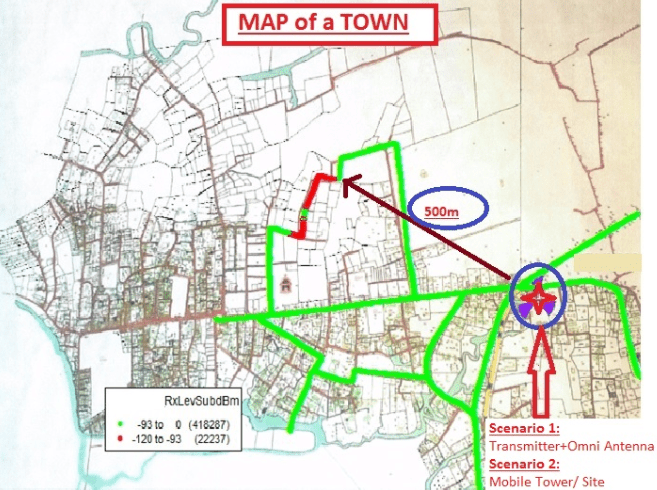
We
have bifurcated all the collected samples in two different parts.
Good Quality received
signal : received level from 0 to -93 dBm (Color GREEN)
Poor Quality received
signal : received level from -93 to -120 dBms (Color RED)
Now
we can see that till 500m distance we are getting GOOD signal level (Color
GREEN) in that particular area of a Town.
Beyond
500m distance in some areas we got POOR signal (Color RED).
If
we consider this part of the town as URBAN, then we can come to a conclusion
that for URBAN area we will consider coverage of a site till 500m distance in
2100MHz band.
If
we do 4, 5 sample test in 4, 5 different URBAN areas of different towns then
accuracy of the conclusion of coverage prediction will be improved.
But
still with 1 sample test also we can conclude to a good value.
Clutter wise sample collection:
So
we have completed CW testing and sample collection in 1 clutter, i.e. URBAN
Now
we will identify a location of the same town or in different town with high
rise congested building area as DENSE
URBAN.
In
DENSE URBAN we may get a GOOD signal level travelling to a distance of 300m
instead of 500m.
In
RURAL area this distance may
increase upto 1.5Km, 2Km or may be upto 4Km depending on the band of Frequency.
More
Frequency band less travelling distance because of more losses in high
frequency.
E.g.
900MHz band signal may travel upto 4Km in rural area, whereas 1800MHz band can
travel upto 2 to 2.5 Km.
So
now we are having collected data/ samples for all 3 category of clutter i.e. DENSE URBAN, URBAN and RURAL.
We
also come to a conclusion that with suppose 2100 MHz band we are getting GOOD signal strength
For
DENSE URBAN-300m
URBAN-500m
RURAL-1.5 Km
Drawback of CW Testing:
Drawbacks
of CW testing are
CW testing model tuning is
based on outdoor coverage only. We don’t collect samples inside a building to measure
indoor coverage.
Time taking method.
Lot of iterations.
Analogous Transmitter.
Rest
it is the best method of sample collections for Model tuning.
In
next blog we will discuss about MODEL
TUNING which is the 2nd Phase of Network/ Radio Frequency (RF)
Planning.
The full form of MRO in telecom is Minimum Roll out obligations.
When an operator gets operating licence for a particular frequency band, e.g. 1800 MHz band then that operator has to comply Minimum Roll-out Obligations.
Here operator has to do roll out (site roll out and provide network services) in District Headquarters (DHQ), Block Head Quarters (BHQ), Towns or SDCAs** (Details of SDCA is mentioned in the end of this blog) based on different frequency band.
The test procedures and the roll out phases all are set by Department of Telecommunications (DoT).
The License owner shall make its own arrangements for all infrastructures involved in rolling out of the network and shall be solely responsible for installation, networking and operation of necessary equipment and systems.
MRO compliance is not accepted if done by using technology of network sharing Intra Circle Roaming.
(This roll out obligation is separated
in phases and in each phase no of DHQ, BHQ or towns to be covered is different.
Suppose in a circle there are 33
districts, then to meet 1st phase of MRO-10% DHQ roll out obligation
an operator has to complete services in 4 DHQs.
10% of 33 DHQs is 3.3. We can’t do 3,
instead we have to complete 4 District Head Quarters.
Any operator which is failed to meet
any phase of MRO will attract huge penalty.
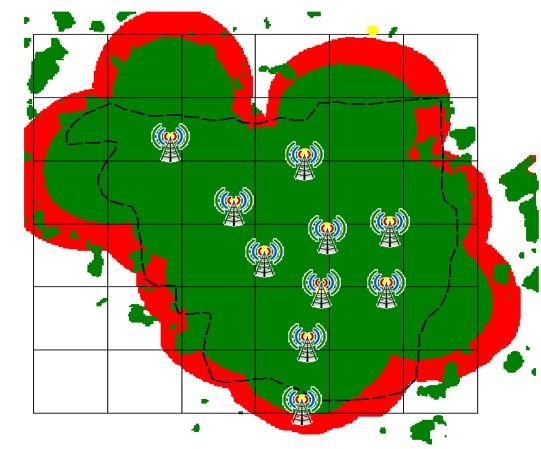
In the above picture GREEN colour
shows acceptable coverage area for a particular DHQ/BHQ/Town boundary.
Planning, testing procedures and details of reports and other related things of MRO we will discuss separately.
Here let us first discuss what are
the phases we have to obey for Minimum Roll-out Obligations and finally about
penalty details.
Phases of
MRO:
For 700 MHz, 800 MHz, 900 MHz &
1800MHz bands:
For Non Metro Licensed Service Area (LSA or Circle)
Phase 1: Coverage of 10% District Headquarters (DHQ)s/ Towns by the end of first year.
Phase
2: Coverage of 50% DHQs/ Towns by the end of three
years.
Phase
3: Coverage of 10% Block Headquarters (BHQ)s by the end of third year.
Phase 4: Coverage of additional 10% BHQs (Cumulative 20% BHQs) by the end of fourth year.
Phase
5: Coverage of additional 10% BHQs (Cumulative 30% BHQs) by the end of fifth year.
For all cases time duration is considered from effective date of license or date of assignment of spectrum whichever is later.
2. For Metro Licensed Service Area (LSA or Circle)
The roll-out obligations for coverage
in metro LSAs shall be coverage of 90% of the LSA within one year from the effective
date of license or the date of assignment of spectrum, whichever is later.
For above two cases frequency band
900MHz and 1800MHz are treated as same.
For 2100MHz band:
For Non Metro Licensed Service Area (LSA or Circle)
Phase 1: 50% of DHQs in the LSA out of which 15%
of DHQs should be in rural SDCA within three
(3) years.
Phase 2: Additional 10% of DHQs in the LSA within four (4) years.
Phase 3: Additional 10% of DHQs in the LSA within five (5) years.
For all cases time duration is considered from effective date of license or date of assignment of spectrum whichever is later.
2. For Metro Licensed Service Area (LSA or Circle)
The licensee required to provide
required street level coverage using the spectrum in 2100 MHz in at least 90% of the LSA within five (5) years from the effective date
of license or date of assignment of spectrum,whichever is later.
For 2300 MHz and 2500 MHz bands:
For Non Metro Licensed Service Area (LSA or Circle)
The licensee of 2300 MHz / 2500 MHz shall ensure that at least 50% of the rural SDCAs are covered within five (5) years of the Effective Date using 2300/ 2500 MHz band of license or date of assignment of spectrum, whichever is later.
2. For Metro Licensed Service Area (LSA or Circle)
The licensee is required to provide
street level coverage as prescribed in the test schedule in at least 90% of the LSA within five (5) years of the Effective Date of
license or date of assignment of spectrum, whichever is later.
Penalty in
MRO:
Any Operator or License owner fails
to comply Minimum Roll-out Obligations, it attracts phase wise huge penalty.
The penalty is applicable for each
phase separately. If an Operator fails to meet prescribed period of time for
two phases, then below mentioned penalties will be applicable twice.
For 700 MHz, 800 MHz, 900 MHz,1800MHz
& 2100MHz bands:
@ Rs. 5 Lakhs per week for
first 13 weeks.
@ Rs. 10 Lakhs for the
next 13 weeks and thereafter
@ Rs. 20 Lakhs for 26
weeks
subject to a maximum
amount of Rs. 7.00 Crores for each phase.
For 2300 MHz and 2500 MHz bands:
@ Rs.15 Lakhs per week for first 13 weeks.
@ Rs. 30 Lakhs for the next 13 weeks and thereafter
@ Rs. 60 Lakhs for 26 weeks
subject to a maximum amount of Rs.
21.00 Crores for each phase
For each of the above two cases delay
more than 52 weeks in a phase will impose maximum penalty amount and assigned
spectrum may also be withdrawn.
**SDCA:
Short Distance Charging Area (SDCA)
is a telecom area which is smaller than the size of a district.
DoT (Department of
Telecommunications) configures entire telecom network in India in to Telecom
Circles (LSA).
Circles are further categorized into
Switching Area (SSA) and Long Distance Charging Area (LDCA) which is equivalent
to size of a district.
LDCA is further divided into Short Distance Charging Area (SDCA) which is smaller in size than district and Taluka.
In my earlier two blogs about MORAN (Multi Operator Radio Access Network) and ICR (Intra Circle Roaming) we have discussed about how MORAN and ICR can be used for coverage expansion.
Both technologies are used for sharing of network between two operators.
There is always a seeker and a provider network.
For the seeker operator the ICR or MORAN sites are new sites for their network.
If both technologies can be used for coverage expansion then why we use MORAN in some cases and ICR in some other cases.
There are some major difference we found when we implement these technologies practically.
For theoretical concept you please go through my earlier two blogs of MORAN and ICR-Intra Circle Roaming.
One major criterion when we use MORAN instead of ICR is Minimum Roll Out Obligation (MRO).
MRO is Minimum Roll out obligation that is set by DoT (Department of Telecommunications).
When an operator gets operating licence for a particular frequency band, e.g. 1800 MHz band there is an obligation set by Government that the Operator has to do roll out (site roll out and provide network services) in District Headquarters (DHQ) and BlockHead Quarters (BHQ).
This roll out obligation is separated in phases and in each phase number of DHQ or BHQ to be covered is different.
E.g. 1st phase of DHQ roll
out obligation required 10% coverage of total DHQs.
Suppose in a circle there are 33 districts, then to meet 10% DHQ roll out obligation an operator has to complete services in 4 DHQs.
10% of 33 DHQs is 3.3. We can’t do 3, instead we have to complete 4 District Head Quarters.
Minimum Roll Out Obligation (MRO) itself is a huge topic. I shall discuss this topic separately.
For now we understood that after getting License Telecom Operator has to complete minimum roll out in some areas as per DoT (Department of Telecommunications) guidelines.
In the end final testing for Quality check of coverage of network of the operator in District Head Quarter (DHQ) or Blok Head Quarter (BHQ) is conducted by TERM Cell (Telecom Enforcement Resource and Monitoring).
During testing TERM Cell representative check the received signal in Drive Test tool.
In drive test tool it shows through which ARFCN (Absolute Radio Frequency Channel Number) we are getting received signal.
ARFNC is directly related to frequency spectrum.
So if we want to complete MRO in a town/ DHQ/BHQ with the help of Network sharing from other Operator we must adopt MORAN (Multi Operator Radio Access Network) instead of ICR (Intra Circle Roaming).
In MORAN only, we use PLMN/ BCCH+TCH of the seeker network. But in ICR we use PLMN/ BCCH+TCH of Provider network only.
So during final testing of MRO it will clearly visible ARFCN/BCCH of the seeker network if we use MORAN.
But in ICR case, testing will be failed as it will show ARFCN/BCCH of provider network only.
This is one major noticeable point in MRO, where we must go for MORAN in lieu of ICR.
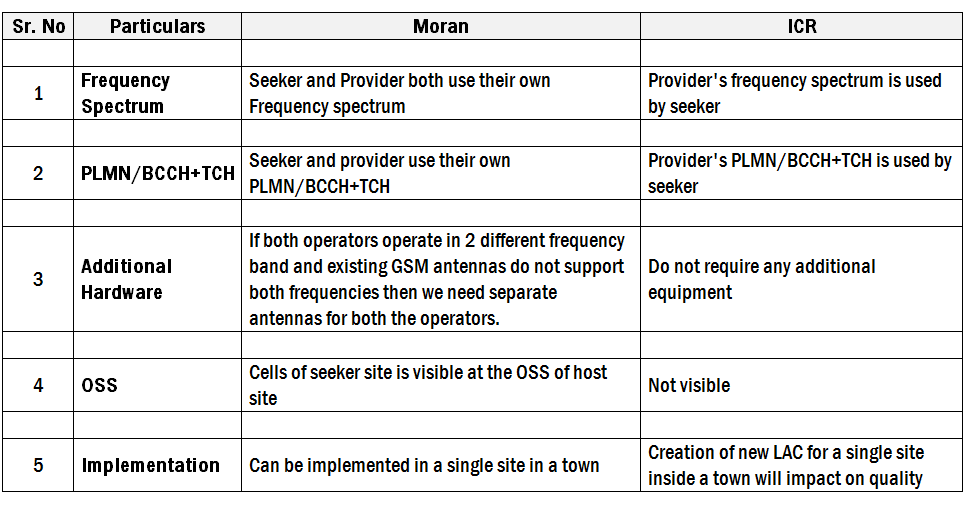
There are some basic noticeable differences between MORAN and ICR when we see practical implementation of these technologies.
Some points are tabulated below-
There are lot many differences during configuration and design of MORAN and ICR.
For more details you may please visit my other blogs on MORAN and ICR-Intra Circle Roaming.
ICR- Intra Circle roaming is sharing of network of one operator with another operator.
The main aim of
ICR is to expand coverage in new locations.
There are two
types of ICR. Normal ICR and Spider ICR.
ICR can be done
on circle basis. E.g. if Operator-A do not have License (2G, 3G or 4G) in a
circle (e.g. Assam, Pune or any circle) then Operator-A can provide 3G network
In that particular circle by doing an ICR agreement with Operator-B which is having operating license in that circle.
On site wise basis Operator-A will take ICR service from Operator-B where Operator-A doesn’t have its footprint.
The above 2 cases we consider as Normal ICR.
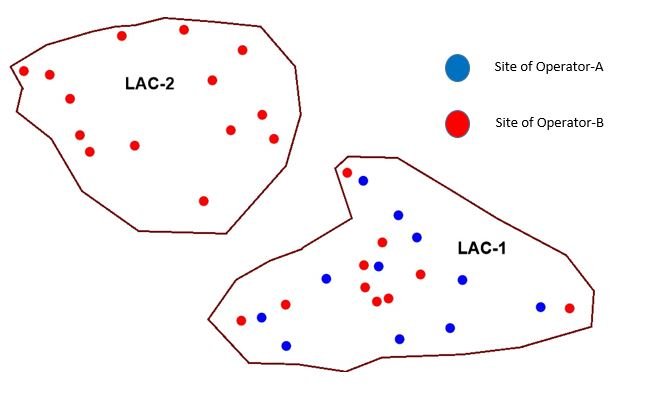
There is a third scenario where in a same town both Operator-A and Operator-B have coverage.
To improve coverage in the black hole locations we can do ICR in between the two Operators.
Such type of ICR is called Spider ICR
Normal ICR:
Normal ICR has two possibilities-
Network level ICR
Site wise ICR
Network Level ICR:
Telecom circles are divided based on geography. E.g. in India there are 23 telecom circles like Assam, North East,UP East, UP West, Kolkata, West Bengal, Pune, Maharashtra etc.
Telecom operators are like Airtel,
Idea, Vodafone, RJio, BSNL, AT&T etc.
In network level ICR, suppose Operator-A doesn’t have license of a particular network service, e.g. 3G in all circles or in some circles.
If one telecom Operator-A doesn’t have license in all circles or in 2, 3 circles then they can take ICR from another Operator-B which is having 3G License in all circles or in those particular circles where Operator-A doesn’t have License.
This type of ICR is easy to implement.
We don’t need to do any new configuration for such kind of ICR.
Operator-B has to open all the LACs (Location area code) of all 3G sites (or 2G or 4G sites) for Operator-A. Then any customer of Operator-A moves to an area where Operator-B has 3G coverage, that customer will automatically latch to the network of Operator-B and will get full 3G services.
Even he will not feel any kind of difference from service point of view.
Sometimes he may require to latch to the network manually or by restarting the mobile if visits to a new circle.E.g. one customer visits from Kolkata to Pune.
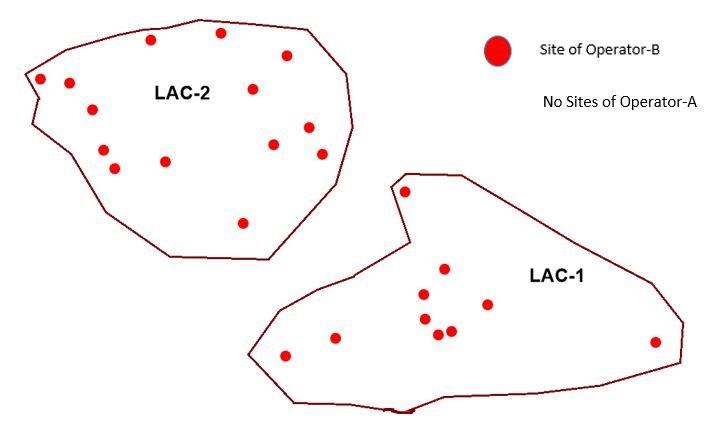
In this scenario both LAC-1 and LAC-2 of Operator-B can be open to Operator-A.
Site wise ICR:
In site wise ICR, network service is shared in some locations where one operator doesn’t have coverage and one is having existing coverage.
If Operator-A doesn’t have coverage in a particular location and Operator-B is having existing network, then Operator-A can take ICR from Operator-B in that particular locations.
In this case Operator-B may need to redefine its LAC based on requirement of sites.
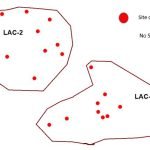
In this case we can open LAC-2 of Operator-B to Operator-A to provide ICR service to the customers of Operator-A. All sites under LAC-2 will provide ICR services.
In the above picture we have seen that Operator-A doesn’t have any sites nearby the LAC-2. So we can offer sites under LAC-2 for ICR purpose.
In some cases we may recreate new LACs based on requirement of sites from the seeker operator (Operator-A in this case).
Spider ICR:
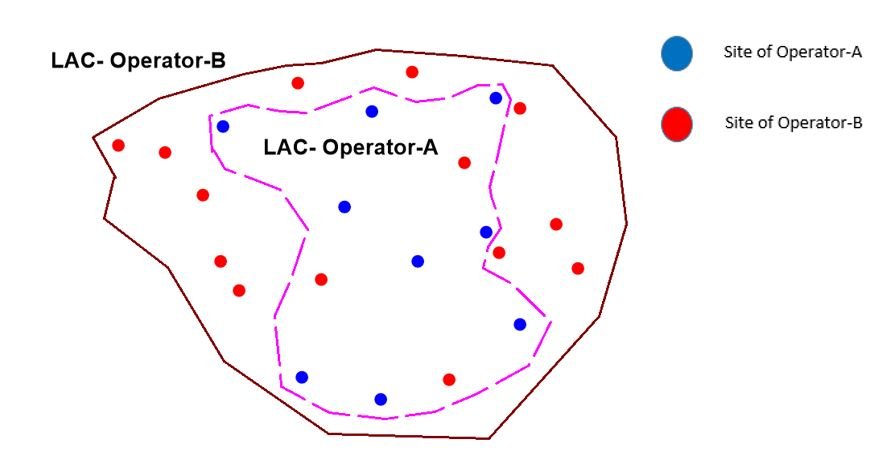
Suppose in a town Operator-A and Operator-B both have their own sites and having coverage.
In some points or locations inside the town there is possibility that in some locations Operator-A is having good coverage but Operator-B doesn’t and vice versa.
In that case both operator can come into an ICR agreement which is called Spider ICR.
Operator-A and Operator-B both will access network of each other and will have a good coverage without any coverage hole if combined spreading of coverage of the two Operators is good.
If a subscriber of Operator-A is roaming inside that town he will latch to the site either of Operator-A or Operator-B based on received signal strength.
Whose signal strength is better based on that subscriber will latch to the sites of that Operator.
This method is very much successful in case of 2G.
But for 4G, practically it shows many difficulties, which finally leads to low data consumption in comparison to No-ICR situation. When 4G Spider ICR reverts to NO-ICR zone, data consumption again takes up its pace as it was earlier.
There is no issue with 2G spider ICR and it works very fine.
In this case LAC-Operator-A is open for Operator-B and LAC-Operator-B is open for Operator A.
A subscriber can access network of both operators continuously without any interruption.
LAC – TAC Mapping:
2G-3G LAC Mapping:
In case of 2G or 3G we only require mapping of LAC. LAC mapping is simple. If a seeker operator is asking for some sites from provider operator and those sites are falling
In some existing LACs and they asked for all the sites of that LAC then the process become very simple and we just have to open those LACs for seeker operator.
Suppose an existing LAC has 50 sites,seeker operator asked for all 50 sites then provider operator just need to open the LAC for the seeker.
If seeker operator is asking for 30 sites for ICR then we have to create new LAC for those 30 sites and remaining 20 sites will have separate LAC. The new LAC created for 30 sites will make open for the seeker operator.
Before creating new LAC we have to properly check whether the LAC formation can be properly done or not and it should not impact badly on PSR (Paging Success Rate) KPI.
Moreover during LAC creation we should take care of highway or major roads. So that due to wrong creation of LAC customers should not go into ping-pong effect, i.e. jumps between 2 LACs continuously which is a wastage of network resource.
4G TAC and 3G/2G LAC Mapping:
In 4G we have to create TAC (Tracking area code) boundary to provide 4G ICR to a seeker operator.
TAC corresponds to the Routing Area
(RA) used in Wideband Code division Multiple Access (WCDMA) and GSM/ Edge Radio
Access network (GERAN).
TA (Tracking Area) consists of a cluster of RBSs having the same Tracking Area Code (TAC). The TA provides a way to track UE location in idle mode.
If seeker operator is asking for 4G ICR then it should have 3G or 2G network within that area for CS fall back(Circuit switch fall back).
It means during 4G connection it is purely packet switched (only data). So to generate or receive call (circuit switch) it requires CS environment.
If 4G network is having VoLTE (Voice over LTE) services and the subscriber is having VoLTE enable handset then till the time he is in 4G coverage area he can talk in 4G network only.
No need to jump to 3G or 4G network until and unless he is out of 4G coverage area and enters into 3G/2G network area where the operator doesn’t have 4G services.
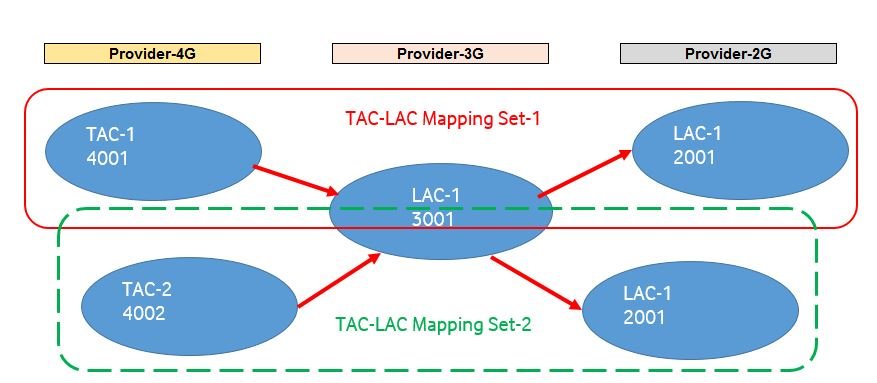
For CS fall back we require TAC- LAC mapping.
TAC-LAC Mapping Principle
One or multiple TACs can be part of one LAC
Multiple LACs can’t be part of one TAC
Now we can take 2 practical scenarios.
Scenario 1:
Provider Network: Provider networks operates on 2G, 3G and 4G
Seeker Network:Operates only on 2G. Seeking ICR for both 3G and 4G.
In this case TAC of 4G of provider,first have to mapped to LAC of 3G of provider and finally to LAC of 2G of seeker network.
Then CS fall back will first happen to 3G network from 4G network and if 3G is also not available then finally to 2G network of the seeker.
These settings/mapping have to done site wise.
If in one site provider does not have 3G network then mapping should be such that CS fall back will directly happen to 2G instead of 3G.
Any subscriber’s mobile will not search for 3G if it latch to such site. It will directly search for 2G network from 4G network.
If 4G site is VoLTE enable and subscriber is also having VoLTE enabled handset then no need of CS fall back.It will operate on 4G network only.
Scenario 2:
Provider Network: Provider networks operates on 2G, 3G and 4G
Seeker Network: Doesn’t have any network. Seeking ICR for 2G, 3G and 4G.
If seeker Operator neither have 4G nor 2G/3G network in a particular location then it requires both 4G as well as 3G/2GICR from provider network.
In this scenario only 4G ICR can’t suffice all requirements.
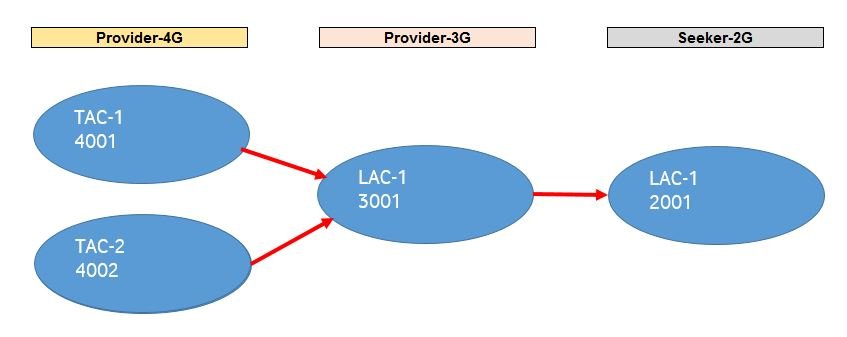
In this case if we do the mapping as like showing in the below mentioned diagram, i.e. 2 4G LACs mapped to 1 3G LAC and then that 3G LAC mapped to 2, 2G LACs then TAC-LAC-Mapping-Set-1 will supersedes TAC-LAC-Mapping-Set-2 and 2nd set of mapping will not work.
So for that either we have to separate one 3G LAC to 2 separate LACs or the 2 LACs of 2G need to combined to 1 2G LAC.
Both arrangement will work properly.
Revenue of Provider from the Seeker operator:
How provider operator would get revenue from the seeker operator it’s totally depends on the agreements between the two operators.
There may be 1, 2 cases.
Site to site basis– here seeker operators has to provide a minimum amount per site per month e.g. 12K per site until some threshold traffic level.
After crossing the threshold level of the allowed traffic cost will be calculated based on traffic usage in addition to the monthly charges.
If traffic of the seeker network goes high revenue of the provider network also goes high.
Take and Give-here both operators come to an agreement that both will provide ICR to each other same no of sites in different locations depending on which operator is dominant in which location. In this case no monetary benefit to anyone from each other, but coverage footprint will increase for both operators.
So through ICR agreement an operator can expand its coverage footprint in new areas without any involvement of CAPEX.