

Would life have been different if we all knew when we were to die?

Imagine a world where we all possess knowledge of the exact date of our demise. It’s a profound thought, isn’t it? At first glance, it may seem unsettling, even macabre. However, a closer look reveals that this hypothetical scenario could potentially lead to a profound transformation in the way we live our lives.

Prioritizing the Essence of Life

One of the most significant shifts that would occur if we knew our death date is our newfound perspective on time and priorities. We would instinctively give precedence to the most valuable aspects of our lives. Instead of dedicating the lion’s share of our time to the office, we’d redirect our focus towards spending quality time with our families.

The rat race that often consumes us, chasing promotions and financial success, would lose much of its allure. We’d realize that, in the grand scheme of things, these pursuits might not hold the same weight as the relationships and experiences that truly matter. Our lives would become less about accumulating wealth and more about accumulating moments of joy and connection.

Chasing Passions, Not Deadlines

In this alternative reality, we’d be less inclined to follow societal norms that encourage us to invest our days in activities we might not be passionate about. Instead, we’d prioritize doing the things we genuinely love. We’d embark on adventures, pursue hobbies, and engage in creative endeavors with a sense of urgency.

The clock would be ticking, but not in the oppressive way we often perceive it. Instead, it would serve as a reminder to seize every opportunity for fulfillment, to make every moment count. We’d be more inclined to follow our hearts and explore our passions, unburdened by the fear of societal judgment or financial insecurity.

Appreciating the Invaluable

Perhaps the most profound change would be our newfound appreciation for the intangible, invaluable aspects of life. The things that have been with us all along, yet often taken for granted, would suddenly hold immeasurable worth.

Our families, the love we share, the happiness we experience, our thoughts, and our creativity would all become treasures beyond measure. We’d nurture these facets of life, invest our time and energy in them, and cherish them as the priceless gifts they are. Knowing our death date would make us acutely aware that these elements are the true essence of our existence.

In conclusion, contemplating the idea of knowing when we will die might initially appear unsettling, but it offers a unique perspective on the way we live our lives. It would lead us to prioritize family, passions, and the intangible gifts life bestows upon us. While we can’t predict the future, we can choose to embrace these values and make the most of the time we have, living a life rich in love, happiness, and authenticity.

Pranab Hazarika

www.PranabHazarika.com

SUBSCRIBE for GROWTH. Discover a life-changing practical TOOL every month
* indicates required

Movies vs Books: Surprising Similarities

Movies and books are similar in nature.

Once you know it, you will start loving both.

Both require significant investment but offer a low price point.

I recently watched the Indian movie “Jawan,”, which had a budget of Rs. 300 crore.

However, the ticket price was only Rs. 300.

Thus, I relished a 300-crore movie experience for just Rs. 300.

In the 67th Indian National Film Award ceremony (Year 2021), Vice President of India M. Venkaiah Naidu conveyed a profound insight:

“Film is the most cost-effective form of entertainment.”

Likewise, when it comes to books:

The investment lies in the years of experience accrued by the author.

The price of a book can vary, typically around Rs. 300 to Rs. 500 or some more.

Authors invest their lifetimes in crafting a book, and readers can absorb their life’s wisdom in just a matter of 2 or 3 days.

For instance, the book “Think and Grow Rich” by Napoleon Hill, published in 1937 after 29 years of research, can now be read within a mere week.
(https://amzn.to/3rCNkGb)

Hence, we can access a wealth of knowledge and experience at a modest cost and in a short timeframe.

Fortunately, I love them both 😊

Pranab Hazarika

www.PranabHazarika.com

SUBSCRIBE for GROWTH. Discover a life-changing practical TOOL every month
* indicates required

Why Kids Master Mobile Devices Faster: Unveiling the Secrets

Why can children operate your mobile device faster than you?

What makes them quicker learners?

This phenomenon finds its explanation in the concept of the Morphogenetic Field.

“Morpho” relates to giving rise to form, and biochemist Alfred Rupert Sheldrake at Cambridge University introduced this concept.

According to the idea of the morphogenetic field, “natural systems … inherit a collective memory from all previous things of their kind.”

Learning, therefore, becomes a cumulative process of intentions.

Similar to human evolution (from monkeys to humans), learning is also an evolutionary process.

In simpler terms, if something we’ve learned, is already part of the morphogenetic field (a field of intention), the next generation can swiftly acquire this knowledge.

Although some people have criticized Alfred Rupert Sheldrake,

However, we still haven’t discovered a more convincing explanation for why children can use their mobile devices more effortlessly and quickly than adults.

If you want to go deep into metaphysical concepts, I can recommend The Ultimate Dr. Deepak Chopra Collection

Pranab Hazarika

www.PranabHazarika.com

SUBSCRIBE for GROWTH. Discover a life-changing practical TOOL every month
* indicates required

How Fast Can Your Mind Bounce Back?

Consider your mental health. How fast can it recover?

You can move swiftly and cover great distances when you’re physically healthy.

Just like your physical health, your mental health can improve faster if you’re in good shape.

Introduction

In our fast-paced lives, we often focus on our physical well-being, striving to stay fit and agile. We push ourselves to cover great distances, be it on foot, on a bike, or in a car. But what about our mental health? How swiftly can our minds recover from the daily challenges and emotional hurdles that life throws at us?

The Parallels Between Physical and Mental Health

Much like our physical health, our mental well-being can recover rapidly when it’s in good shape. Just as a healthy body allows us to move quickly and efficiently, a healthy mind enables us to bounce back from setbacks with ease. However, there’s a crucial factor that affects our mental resilience: the emotional baggage we carry.

The Weight of Emotional Baggage

Imagine your mind as a backpack, and within it, you carry anger, resentment, guilt, and sadness. These emotions weigh you down, making it challenging to move forward in life. The negative energy they generate acts as an anchor, preventing you from focusing on what truly matters.

The Key to Mental Liberation: Forgiveness and Letting Go

So, how can you lighten your mental load and clear your mind of this negative energy? The answer lies in a deceptively simple practice: forgiveness and letting go.

The ‘I RELEASE’ Practice

Begin by taking a deep breath. In that moment of stillness, repeat the phrase ‘I RELEASE’ to yourself. You can say it three times, five times, ten times, or as many times as you feel necessary. This isn’t about saying it aloud for the world to hear; it’s a private mantra for your inner self.

The Power of ‘I RELEASE’

The power of ‘I RELEASE’ lies in its ability to act as a mental reset button. It’s like shedding unnecessary baggage, allowing you to move forward with a lighter heart and a clearer mind. This practice can be performed silently at any moment, whether you’re at home, work, or anywhere else. The key is to do it whenever you feel the weight of negative emotions.

Skepticism and the Simple Solution

But perhaps you’re skeptical. Can something as simple as repeating a phrase really make a difference? The answer is a resounding yes. While it might sound too easy, the ‘I RELEASE’ practice has a profound impact on your mental state. It shifts your focus from dwelling on past grievances to embracing the present moment. You’ll feel an immediate sense of relief and relaxation.

The Power of Letting Go

In a world where we often seek complex solutions to our problems, sometimes the most effective remedies are the simplest. The ‘I RELEASE’ practice is a testament to the power of letting go and forgiving, allowing your mind to bounce back faster and with greater resilience.

Conclusion

In conclusion, just as a physically healthy body can cover great distances, a mentally healthy mind can recover quickly. The key is to shed the heavy burdens of anger, resentment, guilt, and sadness that we often carry. Embrace the ‘I RELEASE’ practice, and you’ll find that your mind can bounce back with remarkable speed. Give it a try, and you’ll experience the instant impact it can have on your mental well-being.

Pranab Hazarika

www.PranabHazarika.com

SUBSCRIBE for GROWTH. Discover a life-changing practical TOOL every month
* indicates required

Earlier, I said YES to the gym; now I say NO…

I have realized one thing.

Life is straightforward. Life is EASY..

Life is BINARY… 1 or 0.
Either YES or NO.

Do you want to be healthy? Your Answer might be definitely YES.

I have the same Answer. I share the same sentiment.

In the years 2017–18, during a routine blood test, a slight increase in my cholesterol levels was detected.

However, my doctor didn’t prescribe any medication. Instead, the prescription was simple: commit to 30 minutes of daily exercise.

I took it seriously and said YES to the gym. I did continuous, two-year-dedicated exercise.

So, my cholesterol became normal, and I was in good shape.

Then, the bumper season of Corona lockdown started, and I stopped going to the gym.

Though, at that time, everyone was conscious of their exercise, I thought it was okay because I had already done a lot.

So I said NO to exercise.

I concentrated more on Netflix and Hotstar in those days.
Though the Lockdown was over and gyms were open, my NO continued to go to the gym and exercise.

So now I have said YES to tablets or medicine to control my cholesterol level.

Life is just in between YES or NO.
You want to be Rich: YES.
Do you want to be an entrepreneur? YES or NO.

But there is a big BUT in some cases. And that BUT makes all the complexity in life.
So try to choose between YES or NO. As much as you can avoid the BUT, life is easy.

Do you want to work out? I think the Answer is definitely YES.

So simple: start exercising, even if it takes one push-up. That’s it…

Pranab Hazarika

www.PranabHazarika.com

SUBSCRIBE for GROWTH. Discover a life-changing practical TOOL every month
* indicates required

Behind simplicity lies a lot of hard work…

Simplifying Education: The Teacher’s Secret

Have you ever had a math teacher who made solving complex equations feel like a cakewalk? 📚🧮 They had a knack for simplifying the most challenging concepts, didn’t they? But have you ever wondered what’s hidden behind that simplicity?

The Teacher’s Dedication: Knowledge and Hard Work

Great teachers, like the one we fondly remember, possess a deep understanding of their subject and put in a tremendous amount of hard work to make it easy for their students. It’s not just about being intelligent; it’s about having the knowledge, dedication, and commitment to teach.

Life’s Lessons: Facing Challenges with Ease

In life, the same principle applies. Those who effortlessly tackle challenges and calmly work through problems have often gathered invaluable life experiences from facing both the ups and downs.

The Wardrobe Chronicles: A Battle of Order and Chaos

Every month, I take some time to organize my wardrobe meticulously. I neatly arrange all my T-shirts, shirts, and everything else in their designated spots. This makes my mornings a breeze for the next week as I can easily find the shirts and T-shirts I need for work.

However, as time goes by, things tend to return to their chaotic, randomly scattered state. By the end of the month, it becomes a challenge to locate the specific T-shirt I want to wear and where it’s hiding.

The cycle repeats itself each month. I set aside one or two hours for the arduous task of rearranging my wardrobe, and this effort simplifies my life for the following week. It’s a constant battle between maintaining order and succumbing to the allure of disorder.

The Hidden Effort: Simplicity’s Paradox

The paradox of simplicity is that it often conceals the immense effort invested in making things appear easy. Consider, for example, cleaning your mobile apps or organizing the files on your laptop. It might seem like a straightforward task, but in reality, it demands time and effort. However, once you’ve invested that effort, it becomes remarkably simple to find what you need.

Organizing Digital Life: Mobile App Mastery

It took me approximately two days to organize all the apps on my mobile device. I created separate folders for different categories, such as video-related apps, finance-related apps, and study-related apps. As a result, I now have just two screens to swipe through on my mobile.

This organization method has made life much simpler. All my apps are neatly grouped in folders, making it a breeze to find specific apps like Netflix or Google Pay.

The Art of Making Complexity Simple

As you read this article, you might find it easy to understand and relate to. But that’s not by chance. Behind these words lies the effort to present complex ideas in a simple and digestible manner.

Acknowledging the Effort: A Tribute to Mastery

So, the next time you see a clear and simple solution to a problem or task, appreciate the hard work that went into making it that way. It’s a testament to human ingenuity and the relentless pursuit of making the complex seem effortless.

In Conclusion: The Mastery of Simplicity

In the end, simplicity is not the absence of effort; it’s the mastery of it.

Pranab Hazarika

www.PranabHazarika.com

SUBSCRIBE for GROWTH. Discover a life-changing practical TOOL every month
* indicates required

You Needn’t Be Exceptional: Success Awaits Ordinary People

Do you ever wonder how many individuals in the world possess the genius of Zeff Bezos, Bill Gates, Elon Musk, or Mukesh Ambani? Or perhaps you ponder the scarcity of modern-day Leonardo da Vinci and Einstein?

These individuals are undeniably rare, and their brilliance is truly extraordinary. But here’s the real question: Do you believe that you, too, can attain such extraordinary status?

The answer may surprise you. While it’s possible, it’s essential to acknowledge that the odds are indeed slim. However, on the flip side of this coin, there are countless ordinary people scattered throughout the world who have achieved remarkable success in their respective fields.

The Power of Ordinary Success

The encouraging news is that you can join the ranks of these individuals. You can become an average person who excels extraordinarily. Success, after all, is a matter of personal choice, and its definition varies from one person to another.

The key is to discover something you are genuinely passionate about, something you can engage in wholeheartedly, even in the absence of an audience to applaud your efforts. When you find that one thing, life becomes simpler and more fascinating.

Finding Your Passion

This pursuit can take many forms — be it reading, writing, drawing, or an endless array of other activities, each unique to the individual. However, it’s crucial to note that this one thing should not be an activity like binge-watching Netflix, which is unproductive and merely a time-waster.

The Path to Happiness and Success

To find happiness and achieve success, there’s no need to be extraordinary or exceptional. Instead, all you have to do is identify that one thing you can do easily and passionately, consistently.

So, the next time you find yourself marveling at the extraordinary, remember that the path to success doesn’t always require extraordinary abilities. 

It simply demands unwavering dedication, passion, and a willingness to embrace your uniqueness. Success is attainable for ordinary people, just like you.

Start your journey today, and who knows, you might be the next name on the list of ordinary individuals who achieved extraordinary success.

Pranab Hazarika

www.PranabHazarika.com

SUBSCRIBE for GROWTH. Discover a life-changing practical TOOL every month
* indicates required

3 Essential Tools for Cultivating Happiness

Here are three tools that can contribute to your happiness:

Mindfulness and Meditation Apps:

There are numerous apps available that can guide you through mindfulness and meditation practices. Apps like Headspace, Calm, and Insight Timer offer guided meditation sessions, breathing exercises, and techniques to help you stay present and reduce stress.

Regular mindfulness and meditation can enhance your overall sense of well-being and happiness.

Gratitude Journal Apps:

Keeping a digital gratitude journal can be a powerful tool for increasing happiness. Apps like Five Minute Journal, Grateful: A Gratitude Journal, and Day One allow you to easily record things you’re thankful for each day.

These apps can help you cultivate a positive mindset and appreciate the positive aspects of your life.

Positive Psychology Tools:

Positive psychology focuses on promoting well-being and happiness. Tools like the VIA Character Strengths Survey can help you identify your strengths and values, allowing you to align your life with what truly makes you happy.

Additionally, resources like the “Happify” app offer science-based activities and games designed to boost your mood and increase overall happiness.

These tools can be valuable aids on your journey to happiness, but remember that happiness is a complex and individual experience. It may require a combination of tools and practices that work best for you.

Pranab Hazarika

** None of the above-mentioned apps are part of sponsorship.

Unveiling the Mysteries: The 7 Hermetic Principles

The 7 Hermetic Principles from “The Kybalion“:

“The Kybalion” explores the teachings of Hermes Trismegistus, an ancient sage. It centers around the seven Hermetic principles, or Universal laws, that govern the universe.

1. Mentalism:

  • This principle asserts that the universe is fundamentally mental in nature. Everything originates from and exists within the realm of the mind.
  • It emphasizes the power of thought and the idea that our thoughts create our reality. Positive, focused thoughts lead to positive outcomes.
  • Mentalism teaches that understanding the workings of the mind is crucial for achieving personal growth and mastery over one’s life.

2. Correspondence:

  • “As above, so below; as below, so above” encapsulates this principle. It means that there is a correspondence or similarity between the macrocosm (the larger universe) and the microcosm (the smaller universe, such as an individual).
  • Understanding this principle allows us to see patterns and connections between seemingly unrelated phenomena. It promotes holistic thinking and the idea that the universe operates according to consistent laws.

3. Vibration:

  • The Vibration principle asserts that everything is in a constant state of motion and vibration, even if it’s not apparent to our senses.
  • Each object, thought, and emotion has its own unique vibrational frequency. Understanding and harmonizing with these frequencies can lead to mastery over one’s experiences and surroundings.
  • This principle underlines the idea that energy and matter are interconnected and mutable.

4. Polarity:

  • Polarity teaches that everything has two opposite poles, or aspects. These opposites are merely extremes of the same thing.
  • Understanding polarities helps find balance and harmony in life. For instance, good and bad are not entirely separate; they are two ends of a spectrum.
  • Mastery over polarities involves transcending extreme positions and finding the middle path.

5. Rhythm:

  • The Rhythm Principle emphasizes the cyclical nature of everything. Life has its ups and downs, and there are patterns and rhythms to these changes.
  • Awareness of these rhythms allows one to make more informed decisions and adapt to life’s fluctuations.
  • By aligning one’s actions with natural rhythms, individuals can enhance their effectiveness and well-being.

6. Cause and Effect:

  • Cause and Effect states that every cause has an effect, and every effect has a cause. There are no random events in the universe; everything happens for a reason.
  • Understanding this principle empowers individuals to take responsibility for their actions and choices.
  • By consciously choosing causes, one can predict and control their effects, leading to more intentional and purposeful living.

7. Gender:

  • In this context, gender doesn’t refer solely to male and female but to the masculine and feminine principles present in all things.
  • Balancing these principles within oneself leads to greater harmony and wholeness. It’s about integrating qualities like action and receptivity, strength and gentleness.
  • Recognizing and embracing both aspects of gender can enhance personal growth and relationships.

These Hermetic Principles offer profound insights into the nature of reality and personal transformation. They provide a framework for understanding the universe and offer practical guidance for achieving greater wisdom and mastery over one’s life.

If You still want to deep dive into these 7 principles, you will find them here.

Pranab Hazarika

5G-NR Frame Structure

Frame, Sub Frame, Slot, Numerology (Subcarrier Spacing)

The 5G New Radio (NR) frame structure is the arrangement of radio resource elements within a time-frequency grid in the 5G wireless communication system. The frame structure in 5G NR is designed to support various types of communication scenarios and requirements, including different bandwidths, subcarrier spacings, and numerologies.

The 5G NR frame structure consists of multiple hierarchical levels, including radio frames, subframes, and slots, each with its own duration and composition. Here’s an overview of the 5G NR frame structure:

  1. Radio Frame:

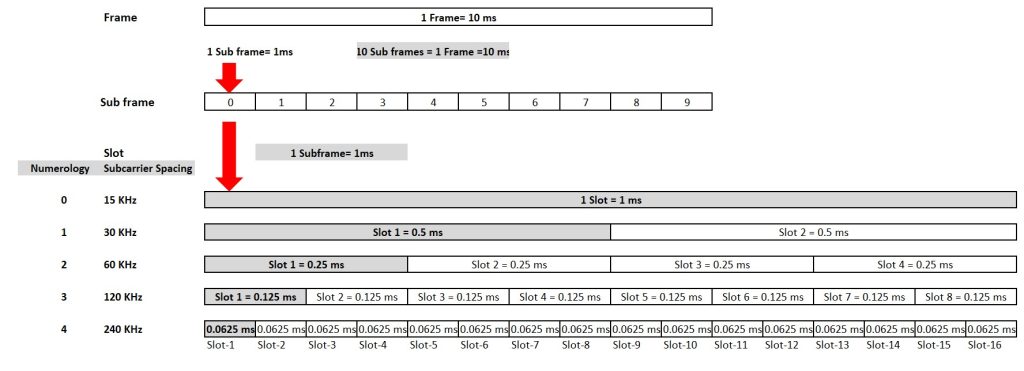
The highest-level structure in the 5G NR frame hierarchy is the radio frame. The radio frame has a duration of 10 milliseconds (ms) and is further divided into 10 subframes. The number of slots in a radio frame depends on the subcarrier spacing and the slot duration.

  • Subframe:

A radio frame is divided into subframes, each with a duration of 1 millisecond (ms).

  • Slot:

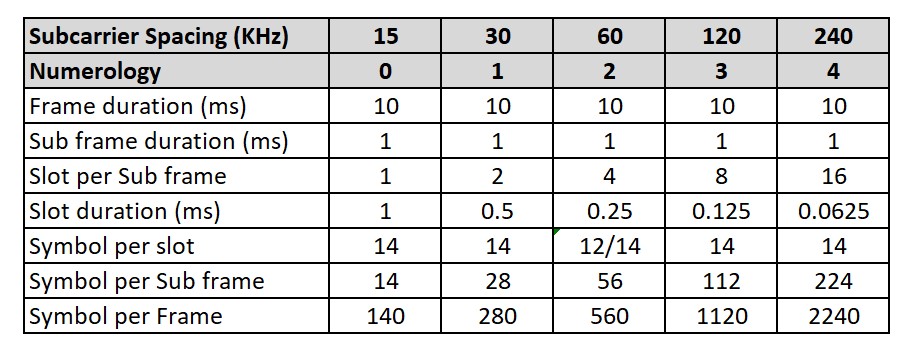
Each subframe is further divided into slots. The number of slots in a subframe depends on the subcarrier spacing. A slot can carry multiple symbols.

  • Symbol:

A symbol is the basic unit of time within a slot. The number of symbols in a slot depends  subcarrier spacing. A symbol carries information in the time and frequency domains.

  • Resource Blocks:

A resource block (RB) is a group of contiguous subcarriers in the frequency domain and symbols in the time domain. The number of subcarriers and symbols in a resource block depends on the subcarrier spacing and the slot duration.

The 5G NR frame structure is flexible and supports different numerologies, which refer to the subcarrier spacing and time duration configurations. The numerology defines the number of subcarriers per resource block, the number of symbols per slot, and the duration of a slot.

Pranab Hazarika

Author || BE || MBA || PMP || IoT Certified ||

https://amzn.to/3XiaIUI